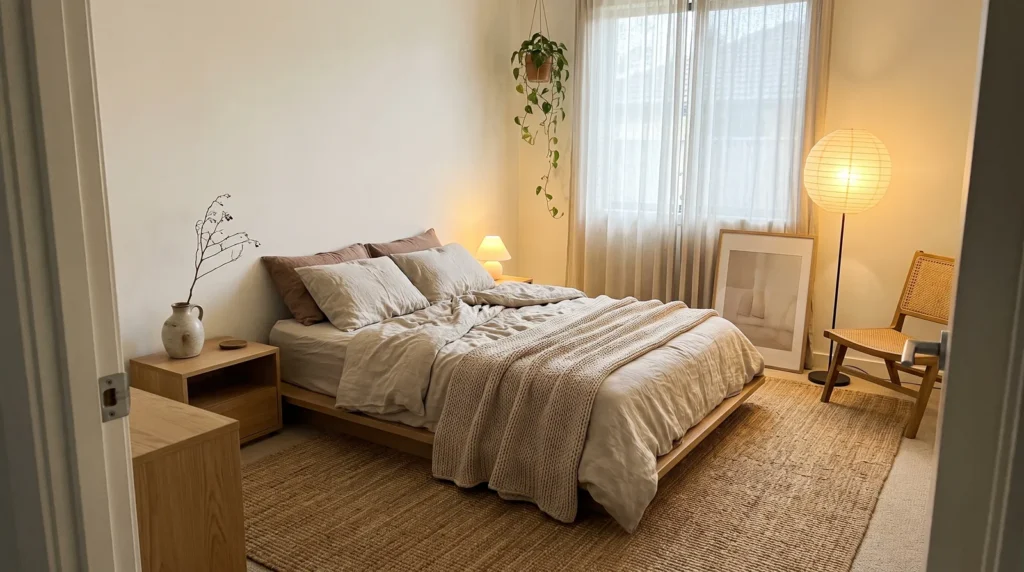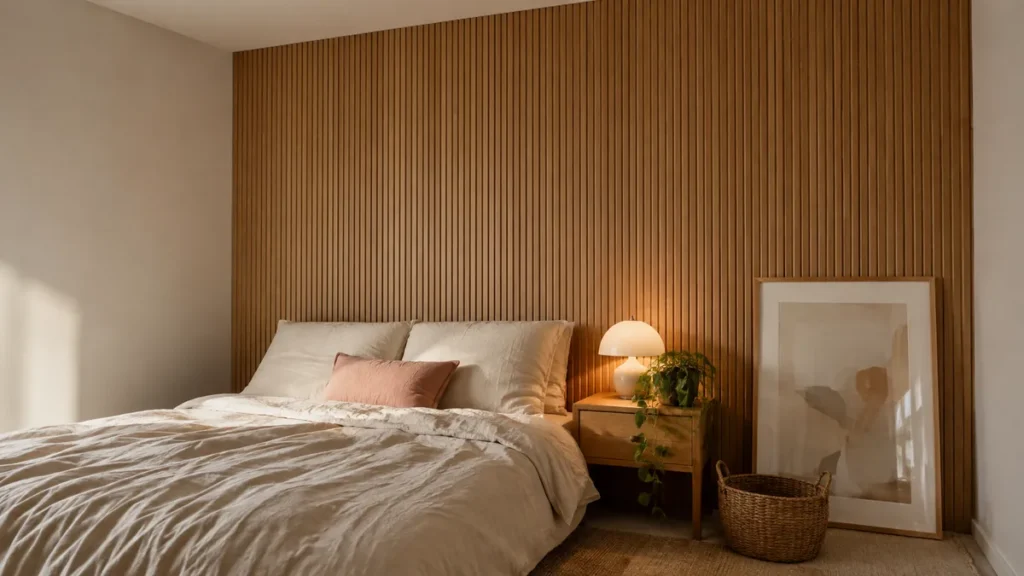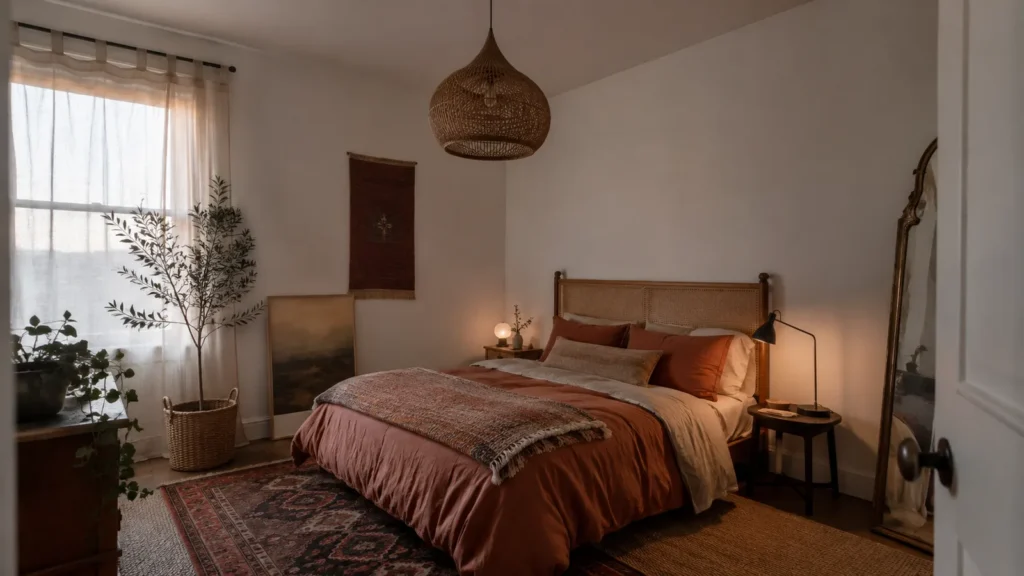
Boho bedroom ideas have a reputation problem. The version that flooded the internet in the late 2010s — mass-produced macramé on every wall, rattan everything, a sea of beige — is genuinely dated now, and most people searching for this look are quietly worried they’ll end up recreating it.
So this guide is built around the version that still looks current: warm, collected, and layered on purpose rather than piled up. Below are 22 ideas covering color, texture, furniture, lighting and the budget workarounds, written for renters working with white walls and a bed they already own.
Ziibra is reader-supported. Some links in this post may be affiliate links, which means we may earn a small commission at no extra cost to you.
What does a boho bedroom actually look like?
A boho bedroom is built on natural materials, layered texture and a warm earthy palette, with a collected feel rather than a matched set. Feather & Black describe the starting point simply: boho bedroom decor begins with nature — textural elements such as rattan, linen and oak that ground the room.
The defining quality is that nothing looks bought at the same time. A boho room reads as though it accumulated — one rug from somewhere, one chair inherited, one thing you made. That’s the effect every idea below is aiming at.
Is boho out of style in 2026?
No — but the mass-produced version of it is. Designers describe the current revival as an alternative to the past five years of extreme minimalism, and it looks noticeably different from its 2010s predecessor.
Rayman Boozer, principal designer at Apartment 48 in New York, told Livingetc he sees the new boho trend as an alternative to the extreme minimalism that has been popular over the past five years, adding that people now realize they have the freedom to mix disparate items rather than keeping everything monochromatic.
The shorthand worth remembering: the trend moved from curated to collected. Matching “boho sets” are the dated part. Genuinely mixed pieces are not.
What makes a boho bedroom look dated?
The dated look comes from buying boho as a theme instead of building it from pieces you actually like. The tell is repetition — the same material, the same three motifs, the same palette everyone else has.
This is the part the pages currently ranking for this search mostly can’t tell you, because most of them are furniture retailers. So, plainly, here’s what ages a boho bedroom:
| Dated boho | Modern boho |
|---|---|
| Rattan on every surface | Woven pieces mixed with something sleek or dark |
| A matching “boho bedroom set” | Pieces from different sources and eras |
| Mass-produced macramé as the focal point | One genuine handmade or vintage piece |
| All-beige, no contrast | Warm earth tones with one saturated accent |
| Every texture stacked in one corner | Texture distributed across the whole room |
| Fake plants in every gap | Fewer plants, real, at varied heights |
Jodi Peterman, CEO of Elizabeth Erin Designs, gives the fix in one line: instead of doing rattan everything, mix woven materials with sleek black accents, sculptural lighting, or vintage florals. Contrast is what stops the room reading as a themed set.
What color palette works for a modern boho bedroom?
Warm earth tones do the heavy lifting: terracotta, rust, clay, sand, olive and warm cream, grounded by natural wood. The update from the dated version is contrast — a palette of nothing but beige is exactly what makes the look feel tired.
1. Anchor on warm earth tones. Terracotta, ochre, olive and warm cream are the boho core. They read as sun-faded rather than trendy, which is why they age well.
2. Add one saturated accent. A single deep tone — rust, forest green, indigo — gives the eye somewhere to land. Without it, layered neutrals blur into one soft mass.
3. Leave the walls neutral if you’re renting. White or warm-white walls are a fine backdrop for this style, and every dollar goes further in textiles than in paint you’ll have to cover later.
4. Repeat each color three times. A rust cushion alone looks random; rust in a cushion, a stripe in the rug and one book spine looks deliberate. Repetition is what makes a mixed room feel intentional instead of accidental.
How do you layer texture without it looking messy?
Spread the texture across the whole room instead of stacking it in one place. Five or six textures distributed over a bed, a floor, a window and a wall reads as rich; the same five piled onto one corner reads as clutter.
5. Distribute, don’t pile. If your bed has the quilt, the throw, the knit cushion and the fringed pillow, and the rest of the room has nothing, the room isn’t layered — the bed is just busy.
6. Vary the scale of your patterns. A large-scale rug pattern, a medium stripe and one small print will sit together happily. Three patterns at the same scale fight.
7. Try the designer’s formula. Rayman Boozer’s go-to for mixing pattern is one stripe, one floral, one big bold statement pillow — always varied in scale. It’s a genuinely useful constraint when you’re unsure how far to push it.
8. Mix woven with something sleek. A cane headboard is better next to a dark metal lamp than next to more cane. Balance comes from contrast, so don’t avoid mixing materials.
9. Include one thing that isn’t new. A secondhand rug, an inherited chair, a flea-market mirror. One genuinely old object does more for the collected feel than five new “boho-style” purchases.
10. Give one piece the focal role. A statement rug or a large wall hanging should lead, and everything else should support it. Two competing focal points is where most boho rooms go wrong.
Which furniture and materials should you choose?
Choose natural materials with visible texture — cane, rattan, solid wood, linen, wool, jute — and let the grain and weave be the decoration. The style doesn’t need ornament, it needs material honesty.
11. A cane or rattan bed, if you’re buying. It’s the fastest way to signal the style, and cane reads lighter in a small room than an upholstered headboard.
12. Wood with visible grain. Oak, mango and teak all work. Painted furniture kills the effect faster than almost anything else.
13. Layer your rugs. A large jute or sisal base with a smaller patterned rug on top is the classic boho floor, and it’s cheaper than one large patterned rug.
14. One handwoven or textured throw. Handwoven throws, relaxed linen bedding, bouclé cushions and tactile rugs are the layers that lift a neutral palette. You need one good one, not five thin ones.
15. Real plants, varied heights. One tall floor plant, one trailing plant up high, one small one on a surface. Fake plants in every gap is a dated-boho signature.
How should you light a boho bedroom?
Layer several warm, low light sources instead of using the ceiling fixture. Rather than relying solely on an overhead light, use shaded bedside lamps for ambient light plus one sculptural floor lamp, with warm-toned dimmable bulbs. If you are renting, a plug-in sconce or a floor lamp gives you the same effect without touching the ceiling wiring.
16. Turn the overhead off. One flat ceiling light flattens all the texture you’ve just spent money layering. This costs nothing and changes the room instantly. There is more on this in our guide to cozy living room ideas.
17. Use warm bulbs, not daylight ones. The bulb color matters more than the lamp. Daylight-white bulbs make earth tones look muddy and gray.
18. Add one sculptural light. A sculptural floor lamp, a raffia shade on a plug-in fitting, or a woven pendant if you are allowed to change the ceiling fixture. This is the piece that does the “sleek or unexpected” contrast job in the lighting layer.
How do you do boho in a small rental on a budget?
Boho is one of the cheapest styles to fake convincingly, because its value sits in textiles and secondhand character rather than furniture. The constraint in a small room isn’t budget — it’s restraint.
19. Thrift the character pieces. Rugs, mirrors, baskets, ceramics and art are all better secondhand, and secondhand is exactly what the collected look requires. This is the rare style where the cheap route is also the more authentic one.
20. Spend on textiles, not furniture. A rug, bedding and curtains change a room more than a new bed frame, and they move with you to the next rental.
21. Hang things without drilling. Adhesive hooks hold most lightweight wall hangings and baskets; a tension rod handles curtains and even a hanging textile. Lean larger art rather than mounting it. Before choosing a rod for a rental window, check our no-drill curtain rod buying guide for sizing, load and surface restrictions.
22. Edit at the end. When the room feels finished, remove two things. Empty surfaces are what separate collected from cluttered, and in a small room that margin is thin.
For a calmer, more pared-back take on the same natural-material palette, see our guide to Japandi bedroom ideas on a renter’s budget — it’s essentially boho’s quieter cousin.
Boho bedroom questions, answered
What is the difference between boho and bohemian?
In practice they describe the same style, but designers increasingly use “bohemian” for the original collected-over-time look and “boho” for the mass-produced version that peaked in the late 2010s. The distinction matters because the collected version is what still looks current.
If it helps, treat “bohemian” as the instruction: things gathered over time, from different places, that happen to work together.
Can you do a boho bedroom in a small room?
Yes, but distribute the texture rather than piling it in one corner, and keep some surfaces empty. In a small room the difference between rich and cluttered is spacing, not quantity.
Scale helps too. One large rug and one large wall piece will make a small room feel considered, where six small objects will make it feel busy.
Does boho work if you can’t paint your walls?
It works especially well on white rental walls. Boho lives in textiles, wood and woven texture rather than wall color, so bedding, rugs and hangings carry the whole look without a drop of paint.
If your rental white is a cold blue-white, warm it with terracotta and cream textiles rather than fighting it with an accent wall you’ll have to paint back.
Bring it together
Modern boho is less about buying boho things and more about mixing things you like and letting the room look collected. Warm earth tones with one real accent, texture spread across the whole room, one piece that isn’t new, warm low lighting — and then the discipline to stop before every surface is full.
If your bedroom is also your living room, the zoning principles in our studio apartment guide apply to all of this.