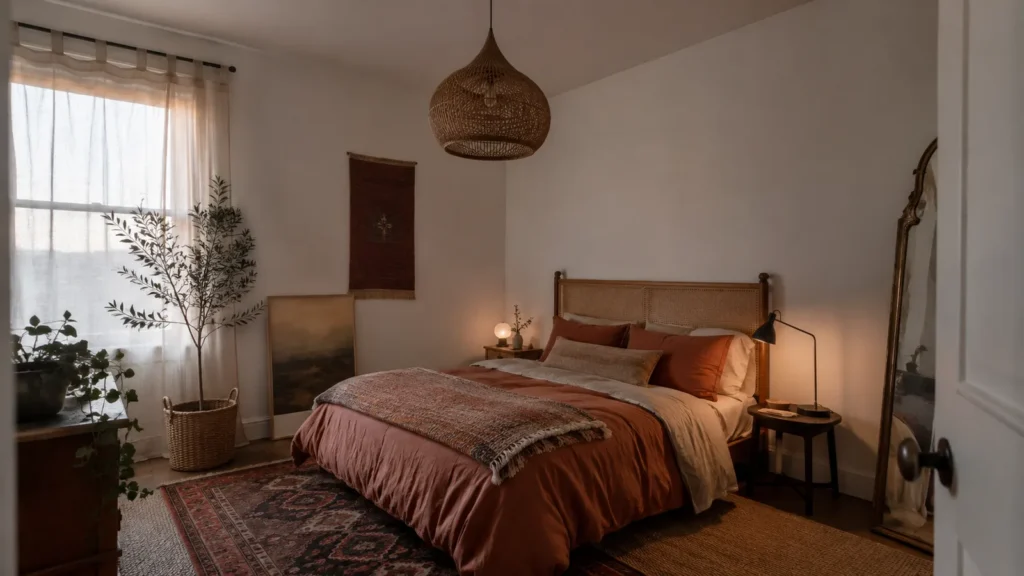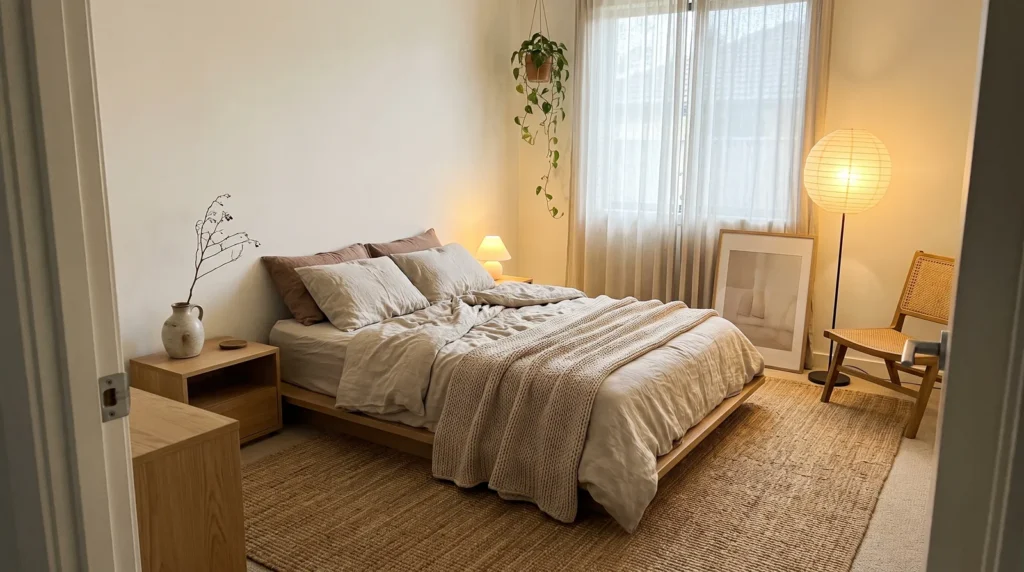
Search for a Japandi bedroom and you’ll mostly find $1,500 platform beds. That’s a shame, because the style itself isn’t expensive — it’s built on restraint, warm neutral color, and natural texture, all of which you can fake convincingly for a fraction of that. Almost none of it needs a landlord’s permission.
Below are 21 ideas organized the way you’ll actually tackle them: color first, then the low-bed look, texture, lighting, and the no-drill workarounds that make it all rental-safe. Everything here assumes you’re working with white walls, a bed you already own, and a budget.
Ziibra is reader-supported. Some links in this post may be affiliate links, which means we may earn a small commission at no extra cost to you.
What is a Japandi bedroom?
A Japandi bedroom blends Japanese minimalism with Scandinavian warmth, so it’s pared back without ever feeling cold or clinical. Feather & Black describe it as a style that merges Japanese minimalism with Scandinavian functionality, drawing on the Japanese practice of zen and the Danish concept of hygge.
That combination is the whole point. Straight Japanese minimalism can read as austere and pure Scandi can read as chilly, but together they produce a room that’s uncluttered and comfortable. Practically speaking, that means few objects, natural materials, warm earthy color, and soft layered light.
Why does Japandi work so well in a small rental?
Japandi is unusually well suited to small rooms, because low furniture and a restrained palette both make a space read as bigger than it is. Comfort Pure notes the style is particularly well suited to smaller rooms — low furniture keeps the room from feeling top-heavy, and the restrained palette makes the space feel larger.
It’s also the rare aesthetic where owning less is the goal rather than a compromise, which is a gift when you’re furnishing a first apartment. And because the look lives in textiles, wood tone and lighting rather than architecture, you can build almost all of it without touching a wall.
Why does my minimalist bedroom feel cold and empty?
Because minimal and warm are two different things, and it’s easy to get the first without the second. A room stripped back to white walls, gray bedding and one lamp isn’t Japandi — it’s just bare, and the fix is warmth in the palette and texture rather than more furniture.
Here’s the version of this room I got wrong first. When I initially tried to make a bedroom feel minimal, I removed things without adding any warmth back in. It was tidy. But with white walls, pale bedding and almost no texture, it read as unfinished rather than calming — like a room someone had just moved out of.
What fixed it wasn’t buying more furniture. It was changing the materials. I swapped the flat white and gray surfaces for warmer off-white and oatmeal tones, brought in wood, and layered linen, cotton and a textured throw. Even switching to a warmer bedside lamp changed the feel of the room more than I expected.
That was the point when Japandi started making sense to me: the goal isn’t an empty room. It’s a quiet room where every material adds a little warmth.
What colors should you use in a Japandi bedroom?
Stick to warm neutrals and let wood tones carry the warmth. Comfort Pure is specific about it: use off-white, ivory, oat, stone, soft clay and warm gray, and avoid cool grays and stark white, which push the room toward conventional minimalism rather than Japandi warmth.
1. Start with a warm white, not a cool one. If you can paint, this is the single highest-impact change and the cheapest. If you can’t, most rental white walls are already neutral enough to work — the warmth will come from everything you put in front of them.
2. Build a small earth palette and stop there. Feather & Black suggest keeping the colors of the earth, forest and sky in mind — rich browns, sandy taupes, pale gray, sage greens, muted blues and soft pinks. Pick four and repeat them; a fifth color is usually the one that breaks the calm.
3. Use one deep accent, sparingly. A muted rust cushion, a forest green throw, or one dark-framed print gives the room somewhere for your eye to rest. One or two placements is the limit — this style loses its quiet fast.
4. If you can’t paint, bring the color in through textiles. Bedding, curtains and a rug cover far more visual area than an accent wall would. On a rental budget this is where your money does the most work.
How do you get the low-bed look without buying a new bed?
You lower the bed you already have rather than replacing it. The reason it matters is proportion: a low bed keeps the mattress close to the floor, emphasizing horizontal lines and making even a modest-sized room feel more open and less top-heavy.
5. Ditch the box spring. Putting the mattress straight onto a low frame or slats drops the whole bed by 6–9 inches and costs nothing. This is the single closest thing to a free Japandi upgrade.
6. Remove the headboard instead of buying one. A tall upholstered headboard fights the horizontal line the style is built on. Taking it off is free, and the wall behind reads as calmer immediately.
7. If you are buying, buy low and plain. A simple platform frame in oak or ash with visible grain and no ornament does the job. Skip anything with a tall headboard, ornate detail, or a high box-spring setup.
8. Bring everything else down to match. A low nightstand, a floor-standing lamp, art hung lower than you’d instinctively place it — the effect only works if the bed isn’t the only low thing in the room.
Which textures make a Japandi bedroom feel warm rather than stark?
Texture is what stops a minimal room from feeling like an empty one. Feather & Black put it well: layers of organic, tactile materials soften the clean lines of minimalist furniture, creating the cozy, inviting feel that defines the style.
9. Layer three textures in one color. Smooth cotton sheets, a slubby linen duvet, and a chunky knit throw in the same oat tone gives you depth without adding a single new color. This is the trick that separates a styled room from a bland one.
10. Choose visible wood grain over painted finishes. Light oak, ash and walnut all carry warmth that painted furniture can’t. Secondhand solid wood beats new painted particleboard here, and usually costs less.
11. Add one woven piece. Rattan, cane, or a jute rug introduces the handmade quality the style depends on. One is genuinely enough.
12. Use linen for the rumpled look. Japandi bedding is meant to look softly lived-in rather than hotel-crisp. Washed linen or cotton-linen blends do this naturally, so you don’t have to style the bed perfectly every morning.
13. Leave deliberate gaps between objects. Empty space between objects is part of the design — the instinct to fill every surface is what works against this style more than anything else. Style your nightstand with two things, not six.
How should you light a Japandi bedroom?
Turn the overhead light off and replace it with several small warm ones. Comfort Pure describes Japandi lighting as layered rather than overhead-dependent — a floor lamp, a table lamp on the nightstand, perhaps a low wall sconce, closer to candlelight than a ceiling fixture.
14. Stop using the ceiling light. A single overhead fixture flattens everything and kills the warmth you’ve just built. Leave it off in the evening and the room transforms at zero cost.
15. Use three low, warm sources instead. A floor lamp, a bedside lamp, and something small and low — a paper lantern or a plug-in sconce. Buy warm-toned bulbs rather than daylight ones; the color of the bulb matters more than the lamp.
16. Filter the daylight instead of blocking it. Sheer or loosely woven curtains keep the light soft rather than harsh, and they read as far more expensive than blackout panels.
How do you create a Japandi bedroom in a rental without drilling?
Nearly all of it is achievable with no hardware and no paint, because the style lives in textiles, wood tone and light rather than built-in features. The few things that usually need mounting — art, curtains, a headboard — all have damage-free equivalents.
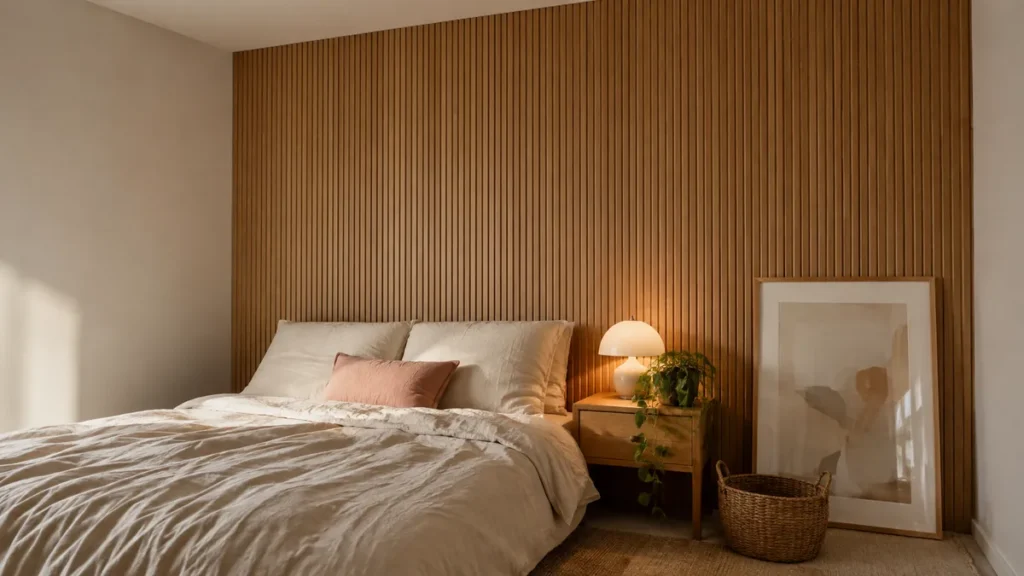
17. Fake the wood wall with peel-and-stick. Removable wood-slat or warm paper panels behind the bed give you the paneled headboard-wall effect and peel off cleanly at move-out. More on this in our accent wall guide. For surface compatibility, sampling, coverage and careful removal, compare the products and caveats in our renter-friendly peel-and-stick wallpaper guide.
18. Lean art instead of hanging it. A large framed print resting on the floor or a dresser is both a Japandi look and a zero-holes solution. It also lets you rearrange without patching anything.
19. Zone with a folding screen. A shoji-style or cane folding screen adds the Japanese half of the aesthetic and can hide a desk or laundry corner. It folds flat when you don’t want it.
20. Hang curtains on tension rods. A ceiling-height tension rod lets you hang curtains high and wide, which makes the room feel taller, without a single screw.
21. Apply the rule of three and stop. One plant, one ceramic piece, one framed print is a complete Japandi styling scheme. Restraint is free, and it’s the part most people skip.
Here’s where the money usually goes versus where it actually needs to go:
| Element | The showroom version | The renter’s version |
|---|---|---|
| Bed | $600–$2,600 solid wood platform frame | Remove the box spring; low frame or slats you already own |
| Headboard wall | Built-in timber paneling | Peel-and-stick wood slat or warm paper panel |
| Palette | Repainted walls in a custom warm white | Existing white walls; color carried by bedding and curtains |
| Texture | Full designer bedding set | Three textures in one tone, layered over what you own |
| Lighting | Hardwired sconces | Plug-in sconce, floor lamp, warm bulbs |
| Art | Gallery framing and hanging | One large leaning print |
| Zoning | Built-in partition | Folding screen |
Japandi bedroom questions, answered
What colors work best for a Japandi bedroom?
Warm neutrals: off-white, ivory, oat, stone, soft clay and warm gray, with deeper accents like muted rust or forest green used sparingly. Cool grays and stark white are the ones to avoid, because they tip the room toward plain minimalism instead of Japandi warmth.
The simplest test is to hold your bedding against a piece of natural oak. If the fabric looks slightly gray or blue next to the wood, it’s the wrong white.
Is Japandi good for a small bedroom?
Yes, it suits small rooms especially well. Low furniture keeps the room from feeling top-heavy, the restrained palette makes the space read as larger, and owning fewer pieces means less competing for floor area.
If anything, a small room makes the style easier. You need fewer pieces to fill it, so your budget goes further on the few things that show.
Can you create a Japandi bedroom in a rental without painting?
Yes. Most of the look comes from textiles, wood tone and lighting rather than wall color, so layered bedding, a woven piece, warm lamps and leaning art will carry the style on white rental walls.
Rental white is usually a neutral base rather than a problem. Where it does fight you — a cold blue-white or a beige-yellow — a warm-toned curtain and bedding will visually correct it.
Bring it together
Japandi looks expensive because it looks considered, not because it costs a lot. Warm up your neutrals, get the bed low, layer texture in one tone, turn off the overhead light, and then stop adding things — that last part is the one that actually makes the room.
Want the same natural materials with more pattern and color? Modern boho bedroom ideas is the warmer, more collected cousin of this look.
If your bedroom doubles as your living room and office, the same principles apply to the whole space: see our guide to studio apartment ideas and how to zone one room.
Want a starting point? Grab our free warm-neutral palette guide and we’ll send you the exact tones to shop for.