Most dorm room essentials lists are written to sell you things. This one starts from the opposite direction: what your dorm already gives you, what it will confiscate, and what your roommate is probably bringing too.
Get those three right and the actual shopping list gets shorter and cheaper. Below is what to buy, grouped by how soon you’ll need it, plus the items that get turned away at move-in more often than anything else.
Ziibra is reader-supported. Some links in this post may be affiliate links, which means we may earn a small commission at no extra cost to you.
What does your dorm already provide?
Almost every residence hall room comes furnished, and buying duplicates of that furniture is the most common way people waste money before term even starts. UT Austin, as a typical example, lists rooms as coming with a desk, desk chair, dresser, extra-long twin bed, microwave-fridge unit, trash can, shelving, hanging space and window blinds.
Your school’s list will differ in the details, so check its housing page before you buy anything large. But the pattern holds nearly everywhere: the furniture, the blinds, and usually a microwave and fridge are already there.
That single check tends to remove the three most expensive things from a shopping list.
What are the actual dorm room essentials?
The genuine essentials are bedding that fits, storage that goes upward, a warm light source, and the small practical items nobody thinks to pack. Everything else can be bought in the first month once you know the room.
Bedding and bath
- Extra-long twin sheets — not regular twin (see below, this is the most common mistake)
- Comforter, blanket, pillows
- Mattress pad
- Towels — bath, hand, washcloth
- Shower caddy and shower shoes, if you’re using a communal bathroom
Storage and organization
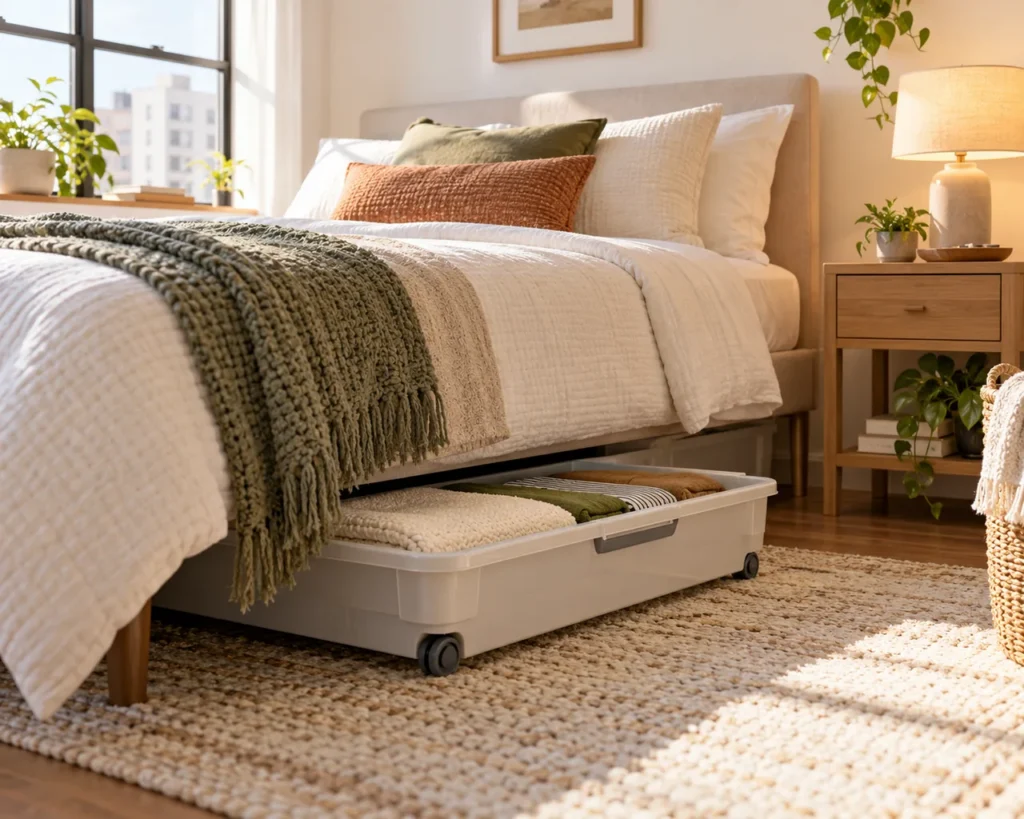
- Under-bed storage bins — compare wheeled organizers by clearance and dorm fit before choosing a size
- Over-door hooks
- One basket for everyday clutter
- Hangers
- Laundry basket or hamper
Study and tech
- Desk or study lamp with an LED bulb
- Headphones
- UL-listed power strip with a built-in circuit breaker
- Removable adhesive hooks and strips
Cleaning and personal
- Basic cleaning supplies and a hand vacuum or dustpan
- Laundry detergent
- First aid kit and any medications
- A lock for the room’s lockable drawer
Often forgotten
- Earplugs
- Spare LED bulbs
- Phone charger — a long one
- Small fan
- Water bottle
What do dorms commonly ban?
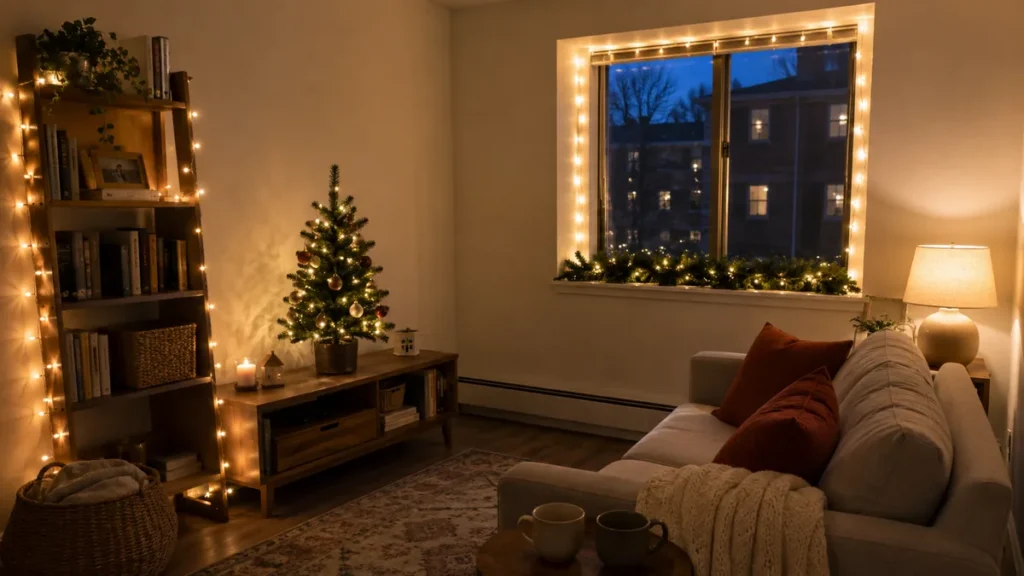
Fire safety rules mean residence halls ban a surprising amount of what gets marketed as dorm decor, and string lights are the item that catches people out most. UT Austin’s list bans decorative lighting including halogen lamps, holiday lights, neon lights, paper lamp shades and rope, string or strip lights — explicitly including LED ones, along with candles and incense.
Here’s what commonly gets turned away, and what to bring instead:
| Commonly banned | Why | Bring instead |
|---|---|---|
| String, rope and strip lights (often even LED) | Fire risk | A warm LED desk or clip lamp |
| Candles and incense | Open flame | A warm-bulb clip lamp |
| Halogen and torchiere lamps | Heat | LED desk lamp |
| Air fryers, toasters, rice cookers, hot plates | Open heating coils | The provided microwave |
| Your own microwave or fridge | Already supplied | Nothing — check first |
| Tape, tacks and nails | Wall damage charges | Removable adhesive strips |
| Space heaters and air conditioners | Fire and power load | A small fan |
| Smart speakers like Alexa or Google Home | Campus network rules | Headphones, phone |
| Your own mattress | Provided furniture must stay | The provided mattress plus a pad |
Policies vary by university, so treat this as the pattern rather than the rule. Your residence hall manual is the only list that actually governs your room, and it takes two minutes to check. The expensive mistake is buying a $40 set of string lights in July and finding out in August.
How do you split the list with your roommate?
Message them before you shop and divide the large items, because two of everything is the fastest way to fill a small room with things you don’t need. UT Austin advises exactly this: consult with your roommate over the summer to avoid duplication of large items and electronics.
The things worth splitting are the ones that only need to exist once: a rug, a fan, a full-length mirror, cleaning supplies, a hand vacuum, a first aid kit. Everything personal — bedding, towels, chargers, headphones — you each need your own.
One awkward conversation in July saves both of you money and floor space in September.
What actually makes a shared room livable?
Less than you think, and it’s rarely the things on the shopping list. The habits and the small comfort items matter more than the size of the room or how well you’ve decorated it.
Here’s what I learned sharing a room. At first I brought far too much stuff, and quickly realized every extra bag, pair of shoes and random storage box made the room feel smaller. A cheap pair of earplugs, a small bedside lamp and one basket for everyday clutter ended up being more useful than most of the things I’d carefully packed.
The hardest part wasn’t space at all — it was getting used to someone else’s sleep schedule, alarms and visitors. After a while we figured out a routine and the room started to feel comfortable rather than temporary.
That’s why earplugs are on the essentials list above and a matching desk set isn’t. In a shared room, the things that protect your sleep and contain your clutter do more work than anything decorative.
What can you skip buying at first?
Almost all the decor. You can’t judge what a dorm room needs until you’ve seen the actual wall space, the actual light and the actual amount of floor left after two people move in.
Wait on: rugs (measure first), wall decor beyond a few adhesive hooks, a full-length mirror (coordinate with your roommate), a printer, extra furniture, and anything described as a “dorm room set.”
Buy immediately: bedding that fits, a lamp, storage that goes vertical, and the earplugs.
The same logic applies here as in our first apartment checklist — live in the space for a week or two before filling it, because the room will tell you what it needs.
Dorm room questions, answered
What size are dorm room beds?
Most residence halls use extra-long twin beds, which are longer than a standard twin. Regular twin sheets won’t fit properly, so check your housing page before buying bedding.
This is the single most common dorm shopping mistake, and it’s an annoying one to fix from a dorm room in week one.
Are string lights allowed in dorm rooms?
Often not. Many universities ban rope, string and strip lights along with halogen lamps and candles for fire safety reasons, even LED versions.
Check your residence hall manual before buying them. If they’re banned, a warm-bulb clip lamp gives you the same soft light legally.
What should you not bring to a dorm room?
Anything with an open heating coil or open flame, your own mattress, and usually a microwave or fridge if the room already has one. Duplicate large items your roommate is bringing are the other big waste.
When in doubt, leave it at home for the first month. Bringing something later is far easier than storing something you can’t use.
Before you start packing
Do three things before you buy anything: read your residence hall manual, check what furniture your room includes, and message your roommate about who’s bringing the big items. That’s maybe thirty minutes, and it will cut your list and your spend more than any shopping guide can.
Then pack light. A dorm room is small, shared, and temporary — and the things that make it feel good are warm light, somewhere to put your clutter, and being able to sleep. For more on the lighting part, see cozy living room ideas; the same warm-lamp principle works in a room this size.