Most small living room ideas quietly assume you own the place. Install floating shelves. Mount the TV. Leave the windows bare. That advice is fine if you can drill into the walls and nobody can see into your ground-floor window — and useless if you can’t.
So this is the renter’s version: the same principles, executed without a drill, plus the two things that get skipped everywhere else — where the TV goes, and the mistakes that make a small room feel smaller than it is.
Ziibra is reader-supported. Some links in this post may be affiliate links, which means we may earn a small commission at no extra cost to you.
What is the best layout for a small living room?
Put the largest piece against the longest uninterrupted wall, leave a clear walking path of roughly two to three feet, and keep the middle of the floor empty. Most small rooms only have one workable layout, and the walking path is what decides it. If you want to check that against real measurements, we’ve mapped what actually fits by square footage.
Work in this order: find the longest wall without a door or radiator, put the sofa there, then place seating opposite or at right angles, then everything else last. Deciding where the sofa goes first removes most of the guesswork, because in a small room it genuinely can only live in one or two places.
If your living room also has to be your bedroom, start with the zoning approach in our studio apartment guide instead — the constraints are different when one room does everything.
What furniture actually fits a small living room?
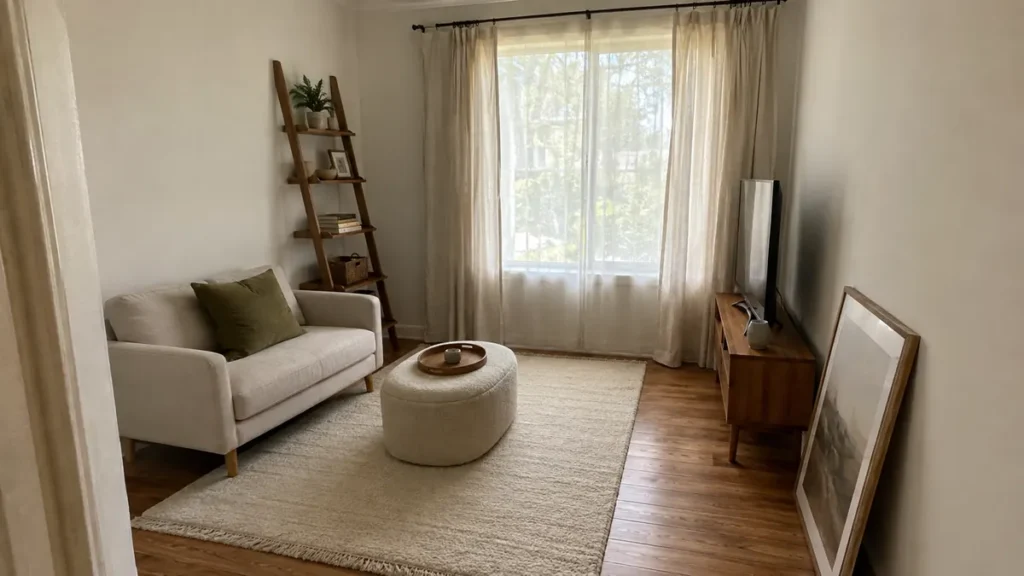
Look for low arms, low backs and visible legs, because those three details make a piece read as smaller than it measures. Room & Board’s design guidance puts it plainly: choose a sofa or loveseat with thin or low arms and a low back, because the slim profile helps your space feel visually light.
1. Measure the wall before you shop, not after. Write down the wall length, the doorway width and the ceiling height. The doorway measurement is the one people forget, and it’s the one that stops a sofa getting into the room at all.
2. Choose low arms over chunky ones. A sofa with slim arms gives you noticeably more sitting space in the same footprint. Wide rolled arms can eat close to a foot of length that you’re still paying for.
3. Buy furniture you can see under. Raised legs let the floor run underneath, and visible floor is what makes a room read as bigger. A skirted sofa that sits flat on the ground blocks that entirely.
4. Pick a sectional only if it’s on legs. The same guidance applies: a sectional with thin or low arms, or one up on legs keeps the space feeling open and airy. A heavy floor-standing sectional in a small room is the single most common furniture mistake.
5. Use one big piece, not several small ones. A loveseat plus two chairs reads as clutter. A loveseat plus one chair reads as a room.
6. Choose a storage ottoman over a coffee table. Seat, footrest, surface and hidden storage in one footprint — the same logic that makes it worth buying in a studio.
How do you get storage without drilling?
Go vertical with freestanding pieces instead of mounted ones, because the height is what you’re after, not the fixing. This is where standard small-room advice fails renters hardest: almost every guide recommends floating shelves, which need wall anchors and leave holes.
7. Use a leaning ladder shelf. It gives you four or five tiers of vertical storage, rests against the wall, and leaves nothing behind when you move.
8. Choose a tall narrow bookcase over a wide low one. Same storage volume, far less floor taken. Secure it with an anti-tip strap, which needs only one small screw rather than mounting the whole unit.
9. Put storage inside the furniture you already need. A storage ottoman, a console with drawers, under-sofa boxes. Storage that isn’t also furniture costs you floor space twice.
10. Hang light things with adhesive strips. They hold most lightweight shelves, hooks and frames, and they come off cleanly. Check the weight rating on the pack and believe it.
11. Lean your art instead of hanging it. A large framed piece resting on a console or the floor reads as deliberate, costs no holes, and is easier to change your mind about. More on this in our accent wall guide.
Where do you put the TV in a small living room?
On the wall your seating already faces, on the slimmest console that fits, rather than mounting it. Mounting means drilling into a rental wall and usually a patching bill when you leave.
12. Don’t build the room around the TV. Decide where the seating works first, then put the TV on whichever wall that seating faces. Rooms arranged around a screen tend to have one usable seat.
13. Choose a console narrower than the TV. A slim, low console keeps the sightline open. Wide media units are where a lot of small living rooms lose their floor.
14. Hide the cables with adhesive raceways. Visible cable runs make a small room feel busier than it is, and stick-on raceways come off without damage.
15. Skip the TV entirely if you can. A projector and a blank wall takes no floor space at all. Not for everyone, but worth considering in a genuinely tiny room.
What makes a small living room feel bigger?
Light passing under and past your furniture, and empty floor in the middle. Those two do more than paint color, and both are free.
16. Hang curtains high and wide. Mount the rod close to the ceiling and extend it past the window frame on both sides. It makes the window look bigger and the ceiling taller, and a tension rod does it without drilling.
17. Don’t leave windows bare for the sake of it. Common advice says maximize light by skipping curtains. In a ground-floor rental that costs you privacy, and bare windows make a room feel unfinished. Sheer curtains give you both.
18. Pull furniture a few inches off the wall. Even two or three inches of breathing space reads as deliberate rather than crammed. Pushing everything flat against the walls is what makes a room feel like a waiting area.
19. Put a mirror where it reflects the window, not the wall. A leaning mirror opposite or adjacent to your window bounces daylight back in. Facing a blank wall it just reflects a blank wall.
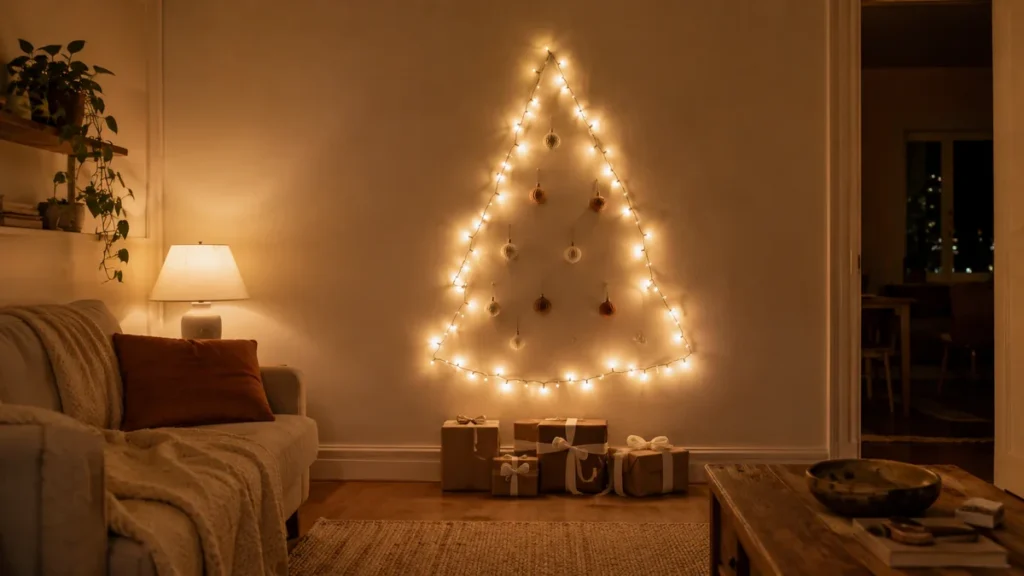
20. Keep the center of the floor clear. Whatever else you do, protect the empty middle. For the seasonal version, see our apartment Christmas decorating guide. It’s the single strongest signal that a room is bigger than it is.
What are the most common small living room mistakes?
Buying furniture that’s too big, pushing it all against the walls, and filling every surface. Nearly every small room that feels cramped has at least two of the three.
| Common mistake | Why it shrinks the room | The fix |
|---|---|---|
| Sofa too deep or too wide | Eats the walking path | Measure the wall and doorway first |
| Everything pushed flat to the walls | Reads as a waiting room | Pull pieces off the wall a few inches |
| Several small rugs | Chops the floor into pieces | One rug large enough for the front legs |
| Lots of small furniture | Multiplies visual clutter | Fewer, larger pieces |
| Curtains hung at the window frame | Makes the ceiling look lower | Hang high and wide |
| Filling every surface | Removes the visual rest | Leave some surfaces empty |
| Mounting a TV in a rental | Holes, and a patching bill | Slim low console instead |
21. Use one rug, and buy it big enough. A rug that only fits under the coffee table makes the floor look chopped up. Aim for at least the front legs of your seating to sit on it.
22. Style surfaces in odd numbers. The 3-5-7 rule — grouping objects in threes, fives or sevens — is a quick way to make a few surfaces look intentional rather than cluttered. We covered how it works in our studio apartment guide.
Small living room questions, answered
What size rug should you use in a small living room?
Big enough that at least the front legs of your seating sit on it. A rug that floats under the coffee table alone chops the floor into sections and makes the room read smaller than it is.
If you are between two sizes, size up. Going too small to save money is the most common rug mistake in a small room, and it costs you the whole visual benefit.
Should a small living room be painted light or dark?
Either can work. Light colors bounce more light around, but a deliberately dark room reads as cozy rather than cramped, so the choice matters less than people assume.
Furniture scale matters far more than paint. A bulky sofa in a pale room still looks bulky. If you are renting and cannot paint anyway, put that effort into the layout and the curtain height instead.
Can you fit a dining table in a small living room?
Usually yes, with a drop-leaf or console table against a wall that opens out when you need it. A round table also suits a tight space better than a rectangular one, because there are no corners to walk around.
Keep it clear of the main walking path. A table that blocks the route from the door will feel wrong however well it technically fits.
Start with the layout
Before buying anything, move what you already own. Pull the sofa off the wall, clear the middle of the floor, and see what the room feels like — most small living rooms improve measurably before a single purchase.
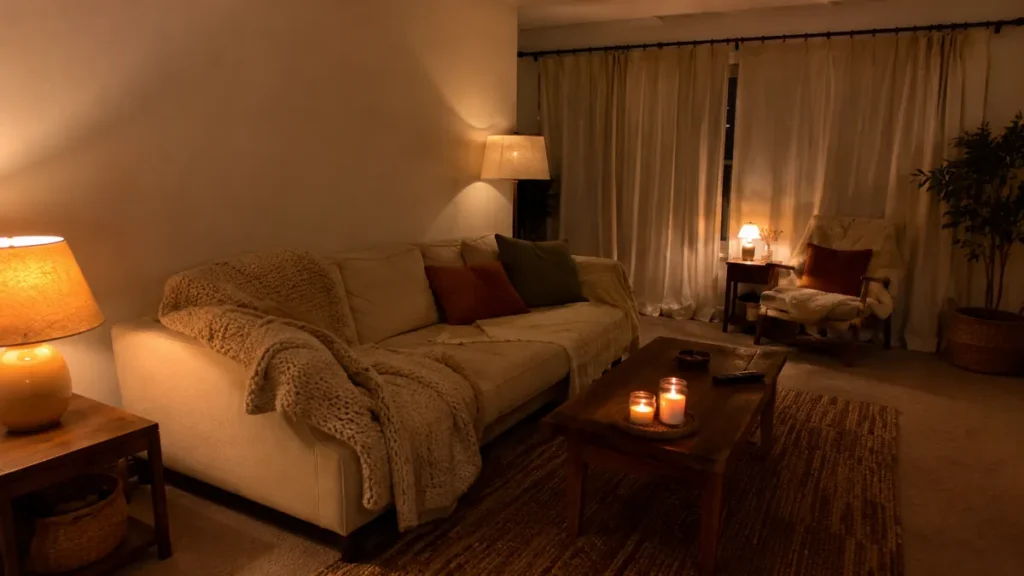
Then fix the light. Warm lamps at a low level do more for a small room in the evening than any amount of furniture, and our guide to cozy living room ideas covers exactly how.