
Ziibra is reader-supported. As an Amazon Associate we earn from qualifying purchases, at no extra cost to you.
Do Command strips damage walls?
Usually no — but there are four conditions where they do: removing them by pulling outward instead of straight down, walls with old or chalky paint, paint applied within the last week, and hanging something heavier than the strip is rated for. Get those four right and they come off cleanly.
That’s a more careful answer than you’ll find on most pages about this, and the difference matters when there’s a deposit involved. Below is when they fail, which product suits your particular wall, and the cases where you should not use them at all.
When do Command strips actually pull paint off?
When the adhesive bonds to the paint more strongly than the paint bonds to the wall. That’s the whole mechanism, and it explains every failure case.
Here’s what happened to me. I used cheap adhesive strips on a painted wall without testing them first, and when I took them down a couple pulled away small patches of paint. Not dramatic, but the kind of thing that gets noticed at a final inspection. Afterwards I kept most of the decorating to furniture, windows and shelves instead.
Two things caused it. The strips were the bargain kind, and I hadn’t tested a single one in a hidden spot before committing to the whole wall.
I ran into the same problem from the other direction with a peel-and-stick accent wall. One corner slowly started lifting where the paint had a slightly dusty, chalky finish. It came off without damage in the end, but removing the adhesive residue took far longer than expected. The lesson both times was the same: wall preparation matters more than the product itself.
That’s the part almost nobody says out loud. You can follow the instructions exactly and still lose paint, because the problem is the wall rather than your technique. Old paint, thin paint, chalky paint and cheap builder-grade paint are all weaker bonds than the adhesive holding onto them.
Which is why the single most useful thing you can do is test one strip in a hidden spot — behind a door, low near the baseboard — and leave it a week before committing. It costs one strip and tells you more than any review.
Why are my Command strips not sticking?
Almost always surface preparation, not a faulty product. Three things account for most failures.
The surface wasn’t cleaned properly. 3M’s own instructions are specific: wipe with rubbing alcohol, not household cleaners or water. Household cleaners leave a residue that the adhesive never grips.
Not enough pressure, or not enough waiting. Press each strip firmly for 30 seconds, then wait a full hour before hanging any weight. Most people hang the item immediately, which is why it’s on the floor by morning.
The room is too cold. Command products are rated for indoor use between 50 and 105°F. An unheated hallway or a garage in December sits below that range, and the adhesive never reaches full strength.
Which Command product should you use?
That depends on your wall and what you’re hanging — and matching the two is where most people go wrong. There are several different versions on the shelf, and buying the wrong one causes more failures than the technology itself.
| Your situation | What you need |
|---|---|
| Smooth painted wall, light item | Command Medium picture-hanging strips (10 lb) |
| Heavy mirror, shelf or large frame | Command X-Large picture-hanging strips (20 lb) |
| Bathroom or humid room | Command water-resistant bath hooks (5 lb) — not standard indoor strips |
| Textured or orange-peel wall | Don’t. See below |
| Wallpaper | Don’t. 3M says so explicitly |
| Painted in the last 7 days | Wait. See below |
| Cold or unheated room | Outside the rated temperature range |
Two rules that apply across all of them. Buy the branded product rather than the bargain equivalent — this is the one place not to save money, and it’s exactly where my paint came off. And check the weight rating on the pack and believe it, because overloading is the second most common failure after bad surface prep.
How much weight can Command strips hold?
It varies by product, and the number on the pack is the one that matters rather than any general rule. Light hooks hold a pound or two; heavy-duty picture strips are rated considerably higher, in pairs.
The practical advice is to round down. If a frame is close to the rated limit, use the next size up or add a second pair of strips. Adhesive doesn’t fail gradually and warn you — it holds, then it doesn’t.
Two things people forget when weighing an item. The frame’s own weight counts, not just the picture inside it, and a cheap poster frame with a glass front is heavier than it looks. And weight ratings assume the load hangs straight down; anything that pulls outward from the wall, like a coat hook with a heavy bag on it, puts far more strain on the bond than the number suggests.
If you’re hanging something over a bed, a sofa or a crib, don’t use the rated maximum at all. Use half of it, or use a fixing that doesn’t rely on adhesive.
Will Command strips work on textured walls?
Mostly no, and this is the clearest “don’t buy” case in the whole article. Adhesive needs continuous contact with a smooth surface, and a textured wall only touches it at the high points, leaving most of the adhesive holding nothing.
Orange peel, knockdown and heavy popcorn textures are all poor candidates. Light texture sometimes works with a heavy-duty strip, but treat it as a coin flip and test one first.
If your walls are textured, freestanding solutions are a better use of your money: a leaning ladder shelf, a tension rod in a window recess, or an over-door hook. Our guide to accent wall ideas covers the no-fixing options in more detail.
How do you remove Command strips without damaging paint?
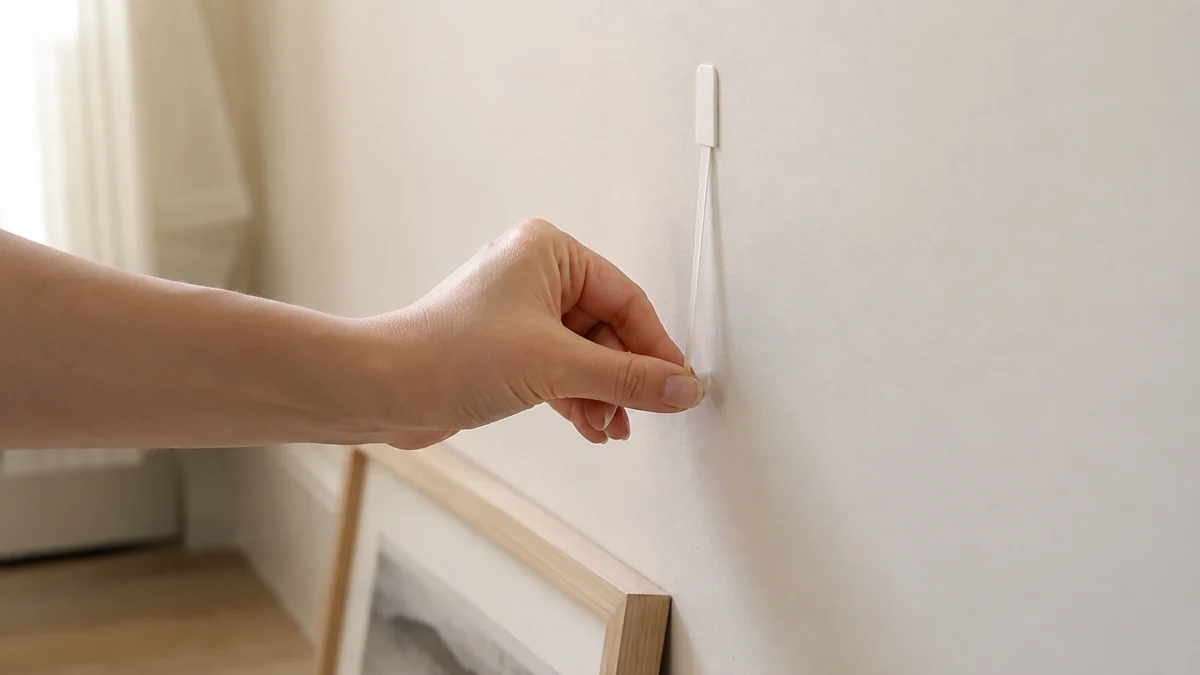
Pull the tab slowly straight down, flat against the wall, and keep stretching. 3M’s own instruction is to stretch the strip at least 15 inches — far more than feels natural — and never to pull it away from the wall.
Step by step:
- Hold the base of the hook gently against the wall with one hand
- Grip the tab with the other and pull downward, not outward
- Keep stretching slowly, up to 15 inches, until it releases
- If it feels stiff or refuses to stretch, warm it with a hair dryer first
If the tab snaps off, don’t start picking. Warm the base with a hair dryer to soften the adhesive, then slide dental floss behind the strip and saw gently downward.
If you’re left with residue, that’s normal and it takes longer than you expect. Work at it with a soft cloth and patience rather than a scraper — this is where people cause the damage they were trying to avoid.
When should you not use Command strips at all?
When the wall, the room or the object is wrong for them. In these cases no technique saves you:
- Wallpaper — 3M says explicitly not to use them, and removal takes the paper with it
- Textured walls — not enough contact area
- Freshly painted walls — wait 7 days; paint keeps curing well after it feels dry
- Anything heavy or irreplaceable — a mirror over a bed is not the place to find the limit
- Cold rooms — below 50°F the adhesive underperforms
- Old or chalky paint — the wall is the weak point, not the strip
For most of these the answer isn’t a better adhesive, it’s not using adhesive. Tension rods, over-door hooks, leaning shelves and freestanding storage do the same jobs with nothing attached to the wall — the approach we take throughout our apartment Christmas decorating guide, where almost nothing touches paint.
Command strip questions, answered
Can you reuse Command strips?
The plastic hook can be reused, but the adhesive strip cannot. Once stretched off the wall it won’t bond properly again.
Keep the hooks and buy replacement strips — they’re sold separately and cost less than a full pack.
Do Command strips work in bathrooms?
The water-resistant range is made for humid rooms, but standard indoor strips are not.
Steam and temperature swings are the usual reason a bathroom hook falls in the middle of the night. Buy the version made for it rather than hoping.
How long can you leave Command strips on a wall?
There’s no fixed limit, but the longer adhesive stays put the harder it gets to stretch off cleanly.
If something has been up for several years, warm the strip with a hair dryer before you start. Old adhesive is brittle adhesive.
Test one before you trust twenty
If you take one thing from this: put a single strip somewhere hidden and leave it a week before committing to a whole wall. Old paint, chalky paint and fresh paint all fail in ways you can’t see by looking.
And if the answer turns out to be that your walls aren’t suitable, that’s useful too. A leaning shelf or a tension rod costs about the same and asks nothing of your paint at all. If you’re setting up a place from scratch, our first apartment checklist covers what’s worth buying in what order.