
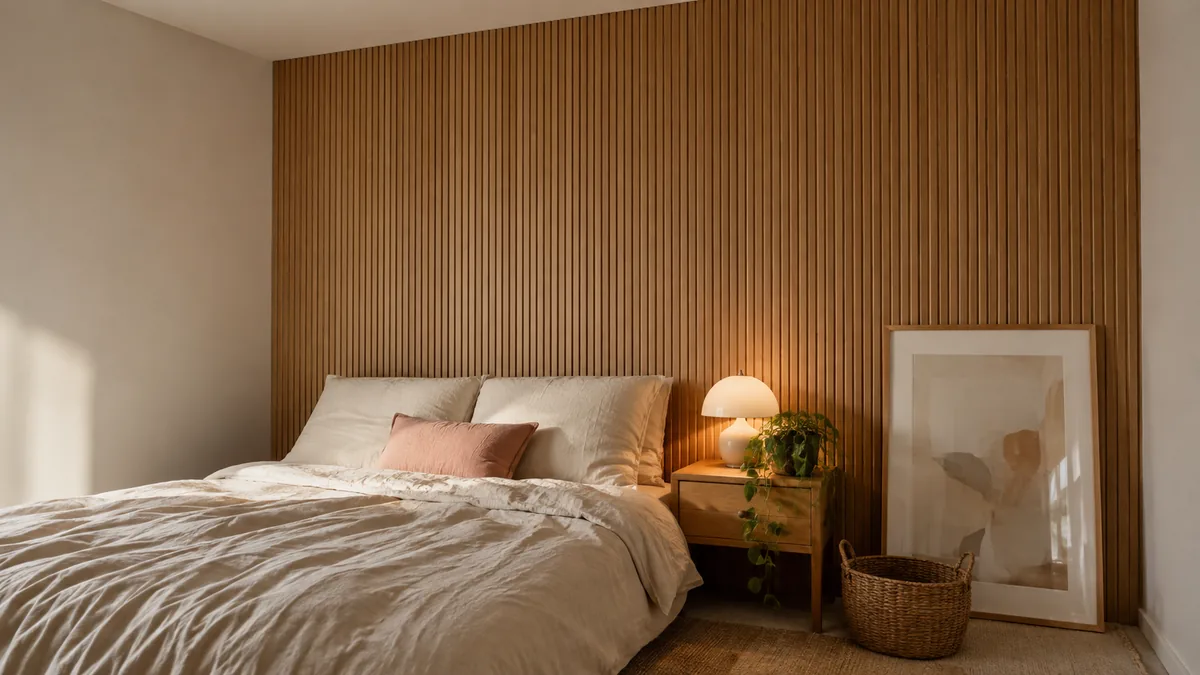
Two questions come up constantly with accent walls: are they still in style, and can you do one without losing your deposit. Almost nothing online answers both.
So this covers the honest verdict on whether accent walls are dated, what designers are using instead, and 20 ways to do one that come off cleanly when you move out. Nearly everything below needs no drill, no nails and no landlord conversation.
Ziibra is reader-supported. Some links in this post may be affiliate links, which means we may earn a small commission at no extra cost to you.
Are accent walls outdated?
Not exactly — but one specific version of them is. The single high-contrast painted wall, one bold color against three plain ones, is the execution that now reads as dated. Accent walls built on texture or tone still look current.
The distinction matters because most “accent wall” advice online is still the 2018 version: pick a bold color, paint one wall, done. That’s the formula people are reacting against, not the idea of giving a room a focal point.
What are designers doing instead?
Rather than contrasting one wall against the others, designers are increasingly wrapping a room in a single color family and building interest through tone and texture. The technique has a name — drenching — and Homes & Gardens describes hue drenching as taking a shade of color and interpreting it throughout a scheme, so you see variations of it across every surface — rather than one flat, uniform color. Applied to an accent wall, that means building interest through texture and tone instead of a single block of contrast.
Designer Uns Hobbs, quoted in that piece, expects it to stick precisely because it isn’t one flat, uniform color: it’s nuanced and considered, and when done well it creates rooms that feel intentional and immersive. Sara Leonor makes a related point — working in shades of one color reads calmer than combining different colors, which can sometimes feel busy or overwhelming.
For a renter that’s genuinely useful, because a tonal scheme can be built almost entirely from textiles. You don’t need permission to drench a room in one color family if the color is coming from bedding, curtains and a rug.
What is the rule for accent walls?
Pick the wall the room already points at, and only one. The wall behind a bed, behind a sofa, or the first one you see from the doorway — a room has a natural focal wall, and choosing a different one fights the layout instead of supporting it.
Two things follow from that. Don’t accent a wall broken up by doors, windows or a radiator, because the effect gets chopped into fragments. And don’t accent the wall you actually face when sitting — you won’t see it, and your guests will be looking at a blank one.
Which accent wall ideas work in a rental?
The ones that add texture or tone without permanent fixing. Ranked roughly by how much difference they make relative to effort:
1. Peel-and-stick wallpaper. The highest-impact renter option by a distance, and the one most likely to go wrong — see the section below before you buy any.
2. Removable wood-look panels. Adhesive slat panels give you the wood-slat look without nails. Heavier ones need more surface prep, so check the weight and the adhesive rating.
3. Drench with textiles instead of paint. Curtains, bedding, a rug and cushions in one color family. No wall contact at all, and it’s the technique designers are actually recommending.
4. Peel-and-stick tile. Works best in a kitchen or bathroom backsplash rather than a full wall. Small area, big visual return.
5. A large leaning artwork. One oversized framed piece resting against the wall creates a focal point with zero fixings.
6. A gallery wall on adhesive strips. Lighter frames only. Check the weight rating on the pack, and don’t push it.
7. A hung textile or tapestry. A large fabric panel on a tension rod or adhesive hooks softens sound as well as looks.
8. Removable wall decals. Better than their reputation now — arches, half-wall shapes and simple murals all come as decals.
9. Half-wall paint, if you’re allowed. Painting to picture-rail height rather than the full wall reads as more considered than a full contrast wall, and it’s less to repaint later.
10. An arch shape in paint. A painted arch behind a bed or desk gives a focal point without needing the whole wall — but the same caveat applies as above: only if you are allowed to paint, and you will need to repaint before you move out.
11. Limewash or textured paint. Texture is what’s replacing flat color. Only worth it if you can paint and expect to stay a while.
12. A shelf-free “shelfie” using leaning pieces. Stack frames and objects on a console against the accent wall instead of mounting shelves.
13. A fabric-covered board. Cover a large piece of foam board or plywood in fabric and lean it — a completely reversible feature panel.
14. Grasscloth-look peel-and-stick. Texture rather than pattern, which ages better and suits a warm-neutral palette.
15. Wall moldings with removable adhesive. Lightweight foam or PVC molding attached with removable adhesive rather than nails, for a board-and-batten look.
Does peel-and-stick actually come off cleanly?
Usually yes, but the wall you put it on matters more than the product you buy. Adhesive needs a smooth, clean, non-chalky surface, and where it doesn’t get one it starts lifting — normally at a corner, and normally after a few months.
Here’s what I learned doing this in a rental. The wall looked great for the first few months, then one corner slowly started lifting where the paint had a slightly dusty, chalky finish. I took it all down before moving out and it came off without damaging the paint — but removing the adhesive residue took a lot longer than I expected.
The lesson was that wall preparation matters more than the product itself. Clean, smooth paint makes an enormous difference. And I’d test a small hidden section first, leave it a week or two, and see whether it holds before committing to the whole wall.
That test is worth the delay. It costs you one offcut and tells you more than any product review will.
What accent wall ideas need no drilling at all?
Everything below touches the wall with adhesive only, or not at all:
16. Lean a full-length mirror. Reflects the room and doubles as the focal point on a narrow wall.
17. Use a freestanding ladder shelf against the accent wall. Adds vertical interest with nothing fixed.
18. Run a picture ledge on adhesive strips. Lightweight ledges hold leaning frames and change without new holes.
19. Add a plant grouping. Three plants at varied heights against a plain wall makes a corner read as deliberate.
20. Light the wall instead of covering it. A floor lamp angled up a blank wall creates a focal point out of nothing — the cheapest accent wall there is.
Here’s how the main methods compare:
| Method | Renter-safe? | Effort | Comes off cleanly? |
|---|---|---|---|
| Peel-and-stick wallpaper | Yes, on smooth walls | Medium | Usually, with residue to clean |
| Removable wood-look panels | Yes | Medium | Usually, check adhesive rating |
| Textile drenching | Yes, no wall contact | Low | Nothing to remove |
| Leaning art or mirror | Yes | Low | Nothing to remove |
| Adhesive gallery wall | Yes, light frames only | Low | Usually |
| Wall decals | Yes | Low | Usually |
| Paint (arch, half wall) | Only with permission | High | Requires repainting |
| Wood slats, nailed | No | High | Leaves holes |
| Board and batten, glued | No | High | Damages the wall |
Where should an accent wall go?
Behind the largest piece of furniture in the room, which is usually the bed or the sofa. That wall already carries the room’s weight, so accenting it reinforces the layout rather than competing with it.
The exception is a TV wall. If your television is the focal point, an accent wall behind it can make the screen harder to watch and the room busier — our small living room guide covers where the TV should go before you decide which wall to treat.
Accent wall questions, answered
How much does a peel-and-stick accent wall cost?
Removable wallpaper is usually sold by the roll, and a standard accent wall typically takes two to four rolls depending on wall height and pattern repeat. Measure your wall and check the roll coverage before ordering.
Pattern repeat is the part people miss. A large repeating pattern wastes more at each drop, which can add a roll you weren’t expecting.
Can you put peel-and-stick wallpaper on textured walls?
Not reliably. Adhesive needs a smooth, clean, non-chalky surface to grip, so heavily textured or freshly painted walls are where it lifts first.
Test a small piece in a hidden spot and leave it a week before covering the whole wall. Freshly painted walls are worth waiting on — paint continues curing for weeks after it looks dry.
What color should an accent wall be?
A deeper tone of a color already in the room usually looks more considered than a contrasting one. High-contrast single walls are the version that reads as dated, while tonal ones still look current.
If you want a shortcut, pick the second-darkest color already present in your textiles and go one step deeper.
Start with the wall the room already faces
If you take one thing from this: the accent wall itself isn’t the problem, the high-contrast painted version is. Texture, tone and a single well-chosen wall still work.
And if you’re renting, test before you commit. For a warmer, more layered take on the same idea, see modern boho bedroom ideas, or for the calmer version, Japandi bedroom ideas on a renter’s budget.