Affiliate disclosure: As an Amazon Associate, Ziibra earns from qualifying purchases. Some links below are affiliate links, at no additional cost to you.
Quick answer: To organize a small closet, first remove what does not belong there, measure the usable width and height, and group clothing by how often you use it. Use matching slim hangers, existing shelves, short stacking containers and a sensible shoe zone before buying complicated systems.
A small apartment closet is not necessarily short on storage; it is often full of poorly arranged storage. Half-empty hangers take up a full rail, shoeboxes conceal forgotten pairs, and out-of-season coats compete with everyday clothes. The goal is to make the closet easier to use while keeping it reversible for a rental.
Measure three dimensions before buying an organizer
Measure the inside width, depth and clear height, then record the existing shelf positions and how far the door opens. Do not assume that a standard organizer will fit between a rail and a door jamb. Hanging units may require extra clearance at the back or bottom, and drawers need enough room to slide forward.
Bring a tape measure to the store or save measurements on your phone. If a storage box is listed at exactly the same width as the opening, allow a practical margin for uneven walls and handles.
Edit the contents in categories
Do not empty your whole apartment at once. Work through jackets, shirts, trousers, shoes and accessories separately. Return what you wear regularly. Put seasonal clothing in suitable storage, and donate or recycle items that are no longer usable to you.
If you share a closet, divide the space by person or function first. Do not throw out someone else’s clothes. Keep a temporary review bag for a small number of uncertain items and set a date to revisit them.
Use the full rail without crushing clothes
Replace an uneven collection of bulky hangers with a consistent hanger shape that suits your garments. Slim hangers may free horizontal space, but delicate knitwear can stretch if hung by the shoulders. Fold heavy sweaters instead.
Group garments by type or length so you can see available space below shorter pieces. Hang long coats together, then use the clear area beneath shorter shirts for a stable low basket or shoe rack, if the floor footprint allows.
Choose shelf dividers and bins for the items you actually keep
Existing upper shelves often turn into a single pile that collapses when you pull out a towel. A few compatible dividers or shallow bins separate categories: spare linens, accessories, off-season items. Do not stack heavy containers above head height where lifting is awkward.
Label the front of bins with ordinary categories and use transparent containers only if seeing the contents is useful. Avoid buying six identical boxes when you only have material for three.
Use shoes as a test of your closet design
Line up your most-used shoes first and measure their total width. A shallow floor rack may work better than over-door storage when the door swings into a narrow hallway. Keep frequently worn pairs easy to reach and store occasional footwear separately.
Check that over-door hooks fit the door thickness and do not obstruct its operation. If a hanging organizer rubs the door trim, remove it rather than forcing the door shut.
Make awkward corners useful
Where a closet is deep, reserve the rear for seasonal storage and the front for frequently worn garments. Avoid creating a second hidden row of everyday items you can never reach. For narrow alcoves, baskets with handles are often easier to retrieve than small loose objects.
A portable motion light may help visibility, but use only a product appropriate for enclosed spaces; do not route extension cords through a closet or place electrical devices under piles of fabrics.
Build a realistic maintenance routine
Once a week, return clean clothes to their assigned area and reset the shoe floor. Once a season, review garments you did not wear. A packed shelf can be a sign that one category has grown too large, not that you need another organizer.
For a move-in inventory before deciding what needs storage, see our first apartment checklist.
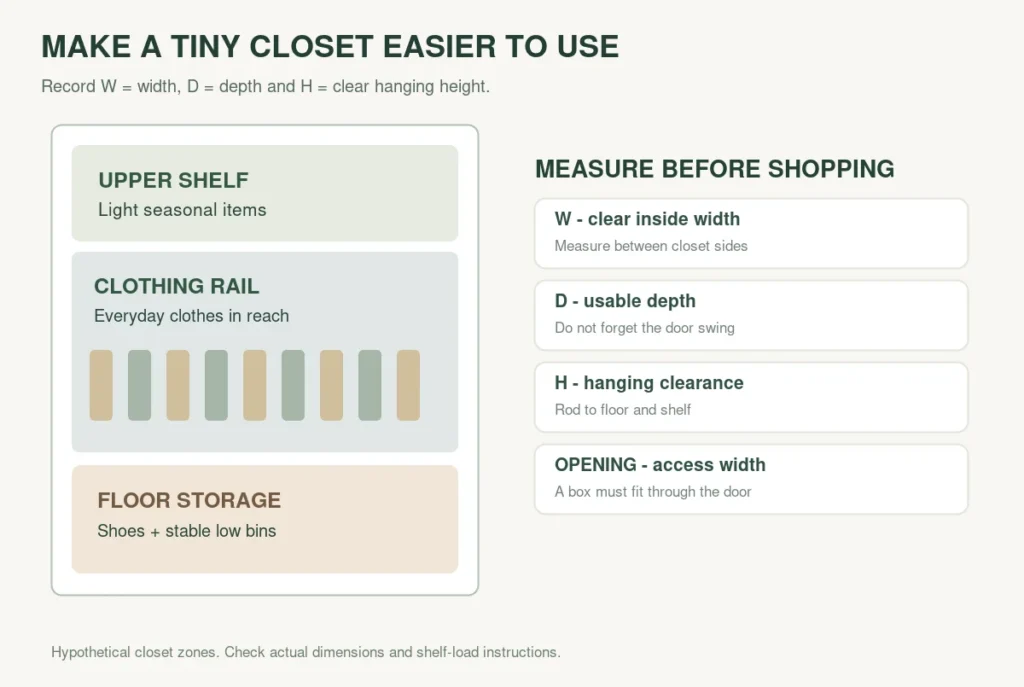
Worked example: organize a 36-inch-wide closet
Imagine a closet opening that measures 36 inches wide. Before buying organizers, measure its usable depth, the rail length between supports and the vertical distance from the rod to the shelf and floor. The door opening might be narrower than the interior width, so an organizer that technically fits inside could still be impossible to insert.
Arrange everyday shirts together on the rail and fold sweaters on an existing shelf. Keep two most-used pairs of shoes accessible at floor level; move seasonal pairs out of this high-traffic zone when suitable. Use an upper bin for light, seldom-used accessories rather than heavy boxes overhead. This is a hypothetical arrangement, not a storage-capacity claim for all 36-inch closets.
Measure and record: clear width (W), usable depth (D), clear hanging height (H), door opening and all shelf positions. Take those dimensions with you before shopping.
Rental-friendly choices versus changes that need approval
| Change | Usually reversible? | Check first |
|---|---|---|
| Loose bins on existing shelves | Yes | Shelf load and dimensions |
| Freestanding floor shoe rack | Yes | Doorway clearance and stability |
| Over-door organizer | Usually | Door clearance, scuffing and hinges |
| New drilled rod or wall shelf | No, leaves holes | Lease, wall type and required fasteners |
| Tension-mounted system | Sometimes | Manufacturer-approved span and surface; pressure marks |
A tension system is not inherently safe simply because it does not drill holes. Use it only within its stated dimensions and load specifications.
Small closet organizers worth comparing
Start with the actual closet width, hanging height and door swing. These products suit different parts of the closet.
-
Amazon Basics slim velvet hangers, 50-pack
When it helps: Streamline the clothes rail for garments suitable for hanging.
Check first: They are not a substitute for editing an overfull wardrobe; fold delicate knits.
-
Gorilla Grip 24-pocket over-the-door organizer
When it helps: Shoe or accessory pockets that use a compatible door instead of a drilled shelf.
Check first: Check for rubbing, door hinge strain, fire-door restrictions and the item's weight capacity.
Selections are based on published specifications and suitability, not hands-on testing. Prices and availability can change; verify the exact Amazon listing and manufacturer instructions before buying.
Frequently asked questions
How do I maximize a very small closet?
Use consistent hangers, store bulky seasonal items elsewhere where practical, group clothing by length and keep low shelves or bins accessible.
Are hanging closet shelves worth it?
They can help light folded items if the closet rod and organizer are rated for the load. Measure their drop and available depth first.
Can I add a second closet rod in a rental?
Only if the exact removable system is designed for the surfaces and load, or the lease allows a securely installed rod. Do not improvise a heavy rod with adhesive hooks.
What should go on the highest shelf?
Light, infrequently used items that can be retrieved safely. Avoid heavy boxes overhead.
The bottom line
A closet should tell you where everything belongs at a glance. Better spacing and fewer duplicates usually outperform an expensive modular system. For room-wide storage planning, continue with our studio apartment planning ideas.