Setting up a studio can feel like a puzzle: one room has to be your bedroom, living room, office, and dining room all at once. The best studio apartment ideas don’t fight that — they lean into it, by dividing the open space into clear zones and choosing furniture that does more than one job. Do those two things well and a small studio starts to feel calm and roomy instead of crowded.
Below are 23 ideas grouped the way you’ll actually use them: zoning first, then layout, furniture, color, and the finishing touches. It’s written for renters and first-timers, so nearly everything here is no-drill and budget-friendly.
Ziibra is reader-supported. Some links in this post may be affiliate links, which means we may earn a small commission at no extra cost to you.
What is a studio apartment, exactly?
A studio apartment is a single open room where the living room, bedroom, and kitchen area all share one space, with only the bathroom walled off behind its own door. In the U.S. they average around 500 to 600 square feet, and plenty run smaller.
Knowing that number helps you plan realistically, and we’ve mapped what fits at each square footage from under 400 up to a one bedroom. You’re not decorating four small rooms — you’re styling one flexible space, which is a very different (and honestly more fun) design problem.
How do you make a studio apartment look good?
The single biggest thing you can do is stop treating one room as if it were several tiny rooms. Define a few clear zones, keep the center of the floor open, and let the space breathe instead of packing every wall with full-size furniture.
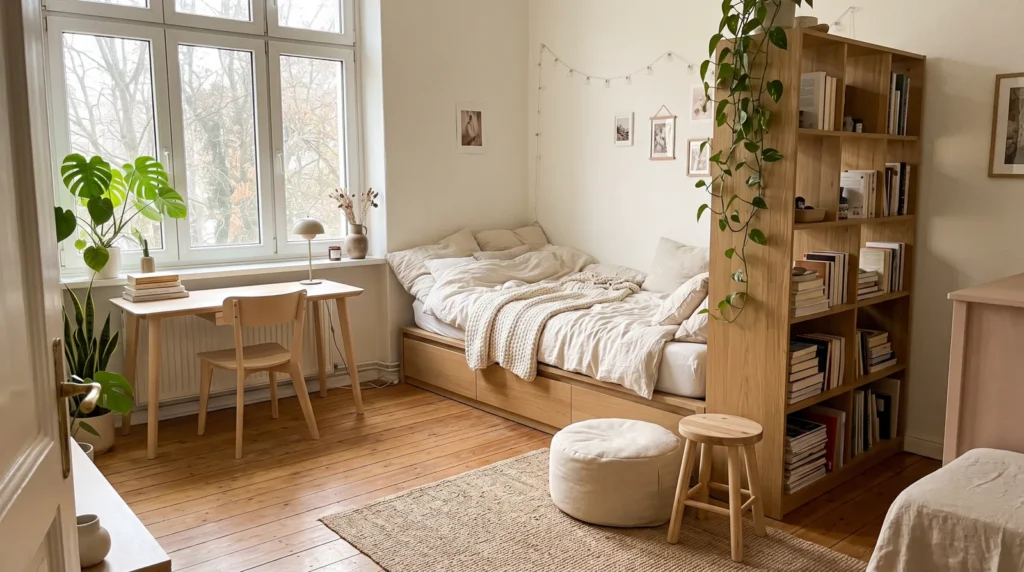
Here’s the lesson I learned the hard way in my own studio. At first I tried to squeeze a full-size version of everything into the room — a real bed, a full sofa, a proper desk, a dining set — treating each function like it needed its own separate corner. It felt cramped and chaotic. What worked so much better was switching to multi-purpose pieces: a daybed with storage underneath, a slim desk pushed against the wall, and low seating. That kept the middle of the room open, and suddenly the same square footage worked comfortably for sleeping, studying, working, and relaxing. The room didn’t get bigger; it just stopped fighting me.
That’s the whole philosophy of this list. Zone the room, keep the center clear, and make each piece earn its place.
How do you divide a studio apartment into zones?
You divide a studio by using rugs, low furniture, curtains, or a shelving unit to mark where one “room” ends and the next begins — no walls required. Apartments.com recommends exactly this: use area rugs, privacy screens, curtains, or a bookcase or trunk set between the living and sleeping areas to define those spaces.
1. Anchor each zone with its own rug. One rug under the bed and another under the seating instantly reads as two “rooms,” even with nothing physically between them. It’s the cheapest zoning trick there is, and it leaves zero marks on a rental.
2. Turn a bookcase sideways. An open-backed shelf between your bed and sofa screens the sleeping area while giving you storage on both sides. Open backs matter — light still travels through, so the room doesn’t feel chopped in half.
3. Hang a curtain on a tension rod. For genuine privacy around the bed, a ceiling-height tension rod and a soft linen curtain create a nook you can open by day and close at night. No drilling, and it comes down in five minutes when you move out. For adjustable floor-to-ceiling systems and other layouts, consult our comparison of renter-friendly no-drill curtain rods before choosing a mounting method.
4. Let furniture backs draw the borders. The back of a sofa or a slim console table quietly marks where your living zone ends. You already own the piece — you’re just turning it into a boundary.
5. Zone with light instead of walls. A floor lamp by the sofa, a bedside sconce, and a desk lamp tell your eye there are three separate areas, especially at night. Skip the single overhead light: one flat ceiling glare makes a studio read as one undivided box. There is more on this in our guide to cozy living room ideas.
6. Use a folding screen for flexibility. A folding screen hides the bed when guests come over and folds flat against the wall the rest of the time. Look for one with cane or fabric panels so it filters light rather than blocking it.
Keep dividers low or see-through wherever you can. Blocking sightlines is what makes a studio feel like a closet; guiding them is what makes it feel styled.
What makes a good studio apartment layout?
A good studio layout keeps clear pathways and an open center, with each zone tucked toward the walls and corners rather than crowding the middle. Float your bed away from the entry where you can, so the first thing you see walking in is your living area, not your pillows.
7. Put the bed farthest from the door. It’s the biggest piece and the most private, so it belongs in the far corner or against the back wall. Everything else in the room gets planned around wherever the bed lands.
8. Protect your walking paths. Leave a clear route from the door to the bathroom and the kitchen area before you place anything else. If you’re turning sideways to squeeze past a chair, the chair is in the wrong place.
9. Face your seating away from the bed. Angling the sofa or chairs toward a window, a rug, or the TV gives your living zone its own focal point. It’s a small move that stops the whole room from feeling like a bedroom with a couch in it.
10. Put the desk where the light is. A wall under or beside a window is the best spot for working, and it keeps the desk out of the room’s center. Good daylight also means you’re not fighting a dark corner every afternoon.
11. Keep the center of the floor empty. There is more on this in our small living room guide. Whether you’ve got a compact 300-square-foot space or a roomier 500, resist the urge to fill the middle. Empty floor is what tricks the eye into reading the whole room as bigger.
Which furniture works best in a studio apartment?
The furniture that works hardest in a studio is anything that does two jobs at once, so you own fewer pieces and free up floor space. Apartments.com puts it simply: make your furniture do double-duty — think a bed with storage under it, or an ottoman that hides clutter and serves as a coffee table.
12. Swap the bed for a daybed with storage. A daybed reads as a sofa during the day and sleeps you at night, and the drawers underneath swallow bedding and off-season clothes. This is the single highest-impact purchase in a studio.
13. Choose a storage ottoman over a coffee table. It’s a seat, a footrest, a surface, and a hidden bin in one footprint. When friends come over it becomes extra seating without you owning another chair.
14. Use a wall-side or fold-down desk. Pushing the desk flat against the wall — or mounting a drop-leaf version that folds away — keeps your work zone out of the traffic path. A fold-down desk is the move if your studio is genuinely tiny.
15. Keep seating low-profile. Poufs, floor cushions, and a small loveseat sit below eye level, so you can see across the room and it feels larger. A tall, deep sectional does the opposite and eats the space.
16. Pick a drop-leaf or console table for meals. It opens up when you’re eating or hosting and collapses against the wall afterward. You get a dining zone without permanently donating floor space to one.
17. Go vertical with tall, narrow shelving. Apartments.com suggests thinking vertically, since shelves and tall bookcases use the space above your head — especially useful in studios with high ceilings. Narrow and tall always beats short and wide when floor space is the scarce resource.
Here’s how the main jobs in a studio map to multi-purpose pieces:
| Studio zone / job | Multi-purpose piece | Why it works |
|---|---|---|
| Sleeping | Daybed or storage bed with drawers underneath | Doubles as a sofa by day and hides bulky items |
| Working / studying | Wall-side or fold-down desk | Frees the center of the floor; folds flat when you’re done |
| Lounging | Low-profile seating (poufs, floor cushions, a small loveseat) | Keeps sightlines open so the room feels larger |
| Coffee table + storage | Storage ottoman | A seat, a footrest, a table, and a hidden bin in one |
| Dining | Drop-leaf or console table | Expands for meals, collapses against the wall after |
| Guests | Murphy bed or sofa bed | Reclaims the whole footprint during the day |
If you buy just one clever piece, make it a storage bed or a storage ottoman — those two solve the biggest studio problems (nowhere to sleep-and-sit, nowhere to hide things) in a single purchase.
What is the best color for a studio apartment?
The safest, most space-expanding choice is one light, cohesive palette used across the whole room. Because a studio is one continuous space, a single family of warm neutrals — soft whites, oat, greige, warm taupe — keeps the eye moving smoothly instead of chopping the room into pieces.
18. Run one palette through the entire room. Using the same three or four tones on the bedding, seating, and curtains makes separate zones feel like one intentional space. Contrast between zones is what makes a small room look cluttered. For a ready-made version of this idea, the warm-neutral Japandi palette is built on exactly that principle.
19. Layer texture instead of adding more color. Linen, rattan, a chunky knit throw, and a jute rug add depth without visual noise. If you want to push that further, modern boho bedroom ideas is built entirely on layered texture. This is how a neutral studio reads as collected rather than flat and beige.
20. Keep window treatments light and airy. Sheer or lightweight curtains hung high and wide let the daylight through, and natural light opens the space and makes it feel larger. Heavy drapes swallow both the light and the wall.
How do you make a studio feel finished instead of sparse?
A studio feels finished when its few surfaces are styled deliberately rather than left bare or piled up. Because you have less to work with, each surface carries more weight — so treat your one shelf or windowsill as a small composition.
21. Style surfaces in odd numbers. The 3-5-7 rule says that grouping objects in odd numbers — ideally 3, 5, or 7 — looks more visually engaging than even-numbered groupings. A stack of books, a small vase, and a candle beats four items lined up in pairs.
22. Hang art high to draw the eye up. Placing art and shelves higher on the wall pulls your gaze upward and makes the ceiling feel taller. In a studio, vertical attention is free square footage.
23. Put a mirror opposite the window. A large mirror facing your best window bounces daylight back into the room and visually doubles the space. Lean it against the wall instead of hanging it and you keep the whole thing renter-safe.
Studio apartment questions, answered
Is a studio apartment cheaper than a one-bedroom?
Usually, yes. Rent is typically priced per square foot, so the smaller the space, the cheaper the rent, and a studio also costs less to heat, cool, and furnish.
The savings go beyond rent. With less room to fill, you simply buy fewer things — which is why a studio is often the most financially forgiving first apartment.
How do you add storage to a studio apartment?
Go vertical and hidden: tall shelving, under-bed bins with wheels, over-door organizers, and furniture with storage built into it like a storage bed or ottoman. The goal is to store things without eating into your open floor space.
Start with the space you’re already ignoring — under the bed, the back of the bathroom door, and the wall above eye level. Those three usually hold more than an extra dresser would, without costing you any floor.
How do you get privacy in a studio apartment?
Use a room divider, a curtain on a tension rod, or a tall bookcase to screen the bed from the living area. None of these require drilling, so they all work in a rental.
If your studio has an alcove or an L-shaped nook, that’s the natural place to tuck the bed. Screening off a corner that’s already partly separate takes far less effort than dividing an open rectangle.
Bring it together
A studio rewards restraint. Pick your zones, keep the center of the room open, choose a few pieces that each pull double duty, and wrap it all in one light, warm palette — that’s how a single room starts to feel like a real home rather than a compromise.
Still buying the basics? Our first apartment checklist covers everything you need room by room, with a free printable.
Want a simple starting point? Grab our free small-space layout cheat sheet and we’ll send you a room-by-room plan you can adapt to your own studio.