Affiliate disclosure: As an Amazon Associate, Ziibra earns from qualifying purchases. Some links below are affiliate links, at no additional cost to you.
Quick answer: A renter-friendly backsplash can change the look of a kitchen, but “peel and stick” does not guarantee that it will come off without lifting paint. Start by checking your lease and the existing wall finish. For a nonpermanent solution, consider products explicitly approved for your surface—or decorate with washable, movable items instead.
Many rental kitchens have a small strip of blank wall between the counter and the cabinets. That makes a backsplash tempting: a few square feet can visually change the room. It also sits near water, food, cleaning products, heat and sometimes gas flames, which makes choosing a material more complicated than covering an ordinary bedroom wall.
Editorial disclosure: We have not installed or removal-tested the options described here. Manufacturer instructions for a specific product and appliance clearance rules take precedence over general decorating advice.
Decide whether the wall is suitable before choosing a pattern
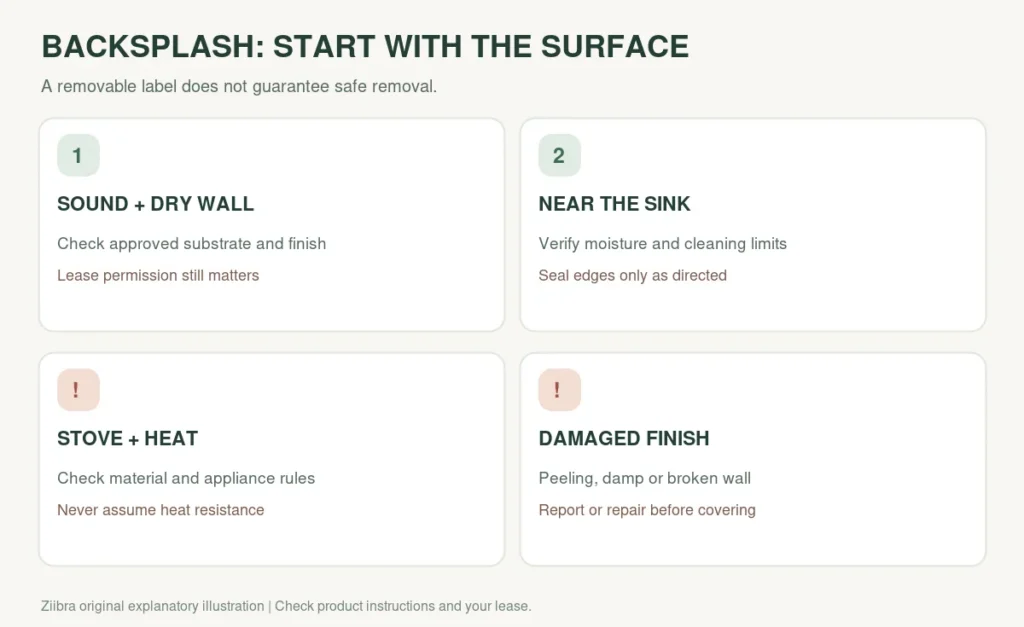
Inspect the backsplash area in daylight. Look for peeling or chalky paint, patches, dampness, uneven grout, cracked tiles, and paint that may not be fully cured. Adhesive products bond to the surface finish—not to the solid wall behind it—so a weak finish can release with the covering.
If the area has wallpaper, loose paint, exposed drywall, serious texture or moisture damage, do not use a decorative covering to conceal the problem. Photograph the existing condition and ask the landlord about repairs before proceeding.
Five backsplash options, compared
| Approach | Visual result | Best circumstance | Main caution |
|---|---|---|---|
| Manufacturer-rated peel-and-stick tile sheet | Tile-like finish | Suitable smooth, dry, approved substrate | Heat and removal limits vary |
| Removable vinyl backsplash film | Flat pattern or faux tile | Approved low-heat wall area | May not handle steam, seams or splashes |
| Freestanding splash panel | Simple solid surface | Where a compatible panel can stand securely | Cleaning, tipping and heat clearance |
| Existing tile cleaned and styled | Fresh without covering | Good underlying tile and grout | Use compatible cleaners and report damaged grout |
| No wall covering—decor nearby | Subtle coordinated color | Unsuitable wall or strict lease | Keep decor clear of burners and water |
Peel-and-stick tile is not all the same product
Some decorative sheets are thicker tile-look panels, while others are thin films. The advertised name tells you little about the adhesive, compatibility, thickness, cleaning method or permitted location. Read the installation guide for the exact product rather than assuming every “removable” option follows the same rules.
Check whether the maker approves painted drywall, existing ceramic tile, the paint type, and exposure to steam. If installation instructions exclude surfaces near heat or open flames, do not treat a decorative photo as permission. Similarly, avoid covering outlets, switches, ventilation openings or appliance instructions.
The stove area needs a separate safety decision
A backsplash behind a range can get much hotter than a wall beside a sink. Decorative vinyl and foam-like panels can soften, discolor or be unsuitable near burners and other heat sources. Never install a product in a heat-exposed zone unless its manufacturer explicitly permits it and all appliance clearances are met. A product being “waterproof” is not the same as being fire- or heat-rated.
If the range area is the part you most want to change and you cannot verify suitability, leave it uncovered. Focus on a safer wall section or use movable countertop accessories placed away from heat and traffic.
How to measure without overspending
Measure the wall width at the top and bottom, then the height at several points. Subtract windows and other large openings only if the manufacturer’s planning method allows. Make a sketch of outlets and corners and note their positions before buying. Pattern matching can create offcuts; a package’s nominal square-foot coverage is not necessarily your finished usable coverage.
Buy a small sample first when available and follow the maker’s testing guidance in an inconspicuous location. Do not treat a successful one-day adhesion test as a guarantee about removal after several months.
Worked example: calculate the area before buying peel-and-stick sheets
Suppose the usable wall section is 84 inches wide and 17 inches tall. Its rectangular area is 84 × 17 = 1,428 square inches, or 9.92 square feet. That is only the starting area, not the number of square feet you should order. Allow for the maker’s required overlaps, pattern matching, trimming and waste, and measure cutouts separately.
Location is part of the measurement: draw a boundary around the stove and other heat-exposed areas that the specific product does not approve. Never use the raw area calculation to justify covering a forbidden surface. If heat-rated suitability or appliance clearances are uncertain, leave that section uncovered.
| Wall condition | Best next step |
|---|---|
| Sound, smooth, dry finish | Check the exact product’s approved substrates and the lease |
| Steam or water splashes | Verify bathroom/kitchen moisture suitability and edge-cleaning instructions |
| Behind a range or near heat | Verify product heat rating and appliance clearances; otherwise do not cover |
| Loose paint, dampness or damaged tile | Report or repair the problem first; do not conceal it |
A careful planning and installation checklist
- Read the lease and get approval when coverings are restricted.
- Confirm the paint and substrate meet the chosen product’s requirements.
- Check sink moisture, burner heat, ventilation and all relevant clearances.
- Clean only as the maker directs and allow complete drying.
- Plan the first row and edge alignment before removing backing.
- Keep outlets accessible and do not alter electrical installations.
- Save the packaging and removal instructions for move-out.
If you uncover electrical issues, leaks, or damaged walls while preparing, stop and report them rather than covering them.
What removal can—and cannot—promise
Adhesive may be marketed as removable yet still damage fragile paint, aged plaster, previously repaired surfaces or poorly primed finishes. Warmth and time can also change how some adhesives behave. Follow the exact removal instructions; do not improvise a heat-gun method around wiring, cabinets or finished surfaces.
For a broader discussion of peel-and-stick suitability, see our peel-and-stick wallpaper guide. Wallpaper and backsplash tile are not interchangeable, but both show why surface preparation matters.
Style ideas that do not depend on permanent tile
For a small galley kitchen, a light, low-contrast pattern keeps visual lines calmer. Warm off-white and simple vertical joints tend to blend with many rental cabinet colors. If a busy pattern is appealing, limit it to a short suitable section rather than wrapping the entire kitchen.
Another option is to make the existing backsplash look more intentional: coordinate a dish towel, a small tray, a cutting board and a plant in one color family. These can be moved to the next apartment and are often lower risk than covering the wall.
A peel-and-stick backsplash product to evaluate
This is a material example for researching an approved wall—not a promise that it will remove cleanly from your rental.
-
Art3d 12 × 12-inch peel-and-stick backsplash tiles (10 sheets)
When it helps: A tile-look finish for a kitchen wall when the exact substrate and moisture conditions are eligible.
Check first: Check the manufacturer's current installation manual and lease, especially regarding heat, steam, wall paint and removal. Do not use behind a stove without specific approval.
Selections are based on published specifications and suitability, not hands-on testing. Prices and availability can change; verify the exact Amazon listing and manufacturer instructions before buying.
Frequently asked questions
Are peel-and-stick backsplashes safe for renters?
They may be suitable where the lease permits them and the manufacturer approves the exact wall, temperature and moisture conditions. They are not guaranteed damage-free.
Can I put peel-and-stick backsplash behind my stove?
Only if the specific product’s instructions allow that application and your appliance clearances are satisfied. Otherwise leave that zone uncovered.
Can I apply peel-and-stick tile over existing ceramic tile?
Some products permit it on sufficiently flat, clean ceramic tile; others do not tolerate grout depth or surface texture. Follow the exact product’s substrate rules.
Will a removable backsplash damage paint when removed?
It can, especially on weak or previously damaged paint. Test only as instructed and do not assume the word removable guarantees a perfect finish.
Final takeaway
The best rental kitchen upgrade is the one you can maintain safely and reverse within your lease rules. Start with the wall, then choose the material—not the other way around. For more low-commitment ideas, read how to decorate a rental on a budget.