Affiliate disclosure: As an Amazon Associate, Ziibra earns from qualifying purchases. Some links below are affiliate links, at no additional cost to you.
Quick answer: To declutter a small apartment, work in short passes by category—not by emptying the entire room. Start with obvious rubbish and items that belong elsewhere, then make one decision at a time about duplicates, useful belongings, and things you no longer need. Only buy organizers after you know what remains.
In a small home, clutter builds up at the boundaries: the entry table, the chair beside the bed, the kitchen counter and the area around the sofa. The solution is not to hide everything in attractive baskets. It is to reduce what needs a home, then give the things you use a predictable place to return to.
Editorial note: This is a practical organization framework, not a claim of personal home testing or a promised transformation in a fixed number of hours. Adapt it to your mobility, household and space.
Start with a 15-minute reset, not a whole-apartment cleanout
Choose one visible surface, like the coffee table, and set a timer for 15 minutes. Bring a rubbish bag, a recycling bag, a donation box, and a small “belongs elsewhere” basket. Remove obvious rubbish first. Put dishes in the sink, return chargers to their usual home, and set aside anything you have stopped using.
Do not start by buying containers. You will not know the correct number or size until you have edited the contents. Stop when the timer ends and put the donation box near the exit so it does not become another permanent pile.
If you live with others, decide which shared items can be moved before taking anything apart.
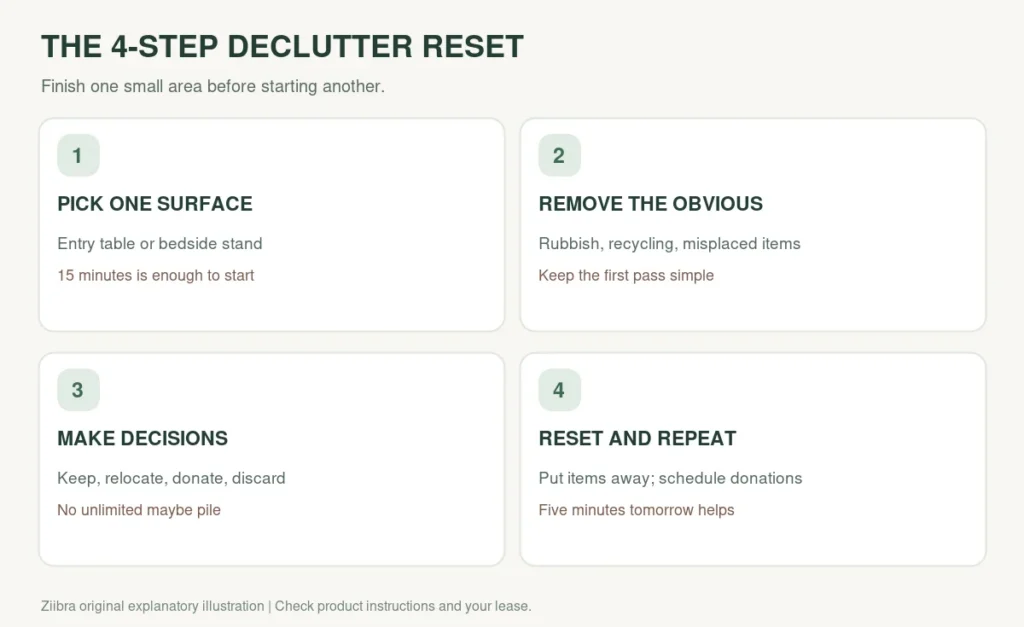
Use four decisions for every object
| Decision | What it means | Next action |
|---|---|---|
| Keep here | Used in this room often | Assign an accessible home |
| Keep elsewhere | Useful, but stored in the wrong room | Return after the session |
| Donate or sell | Good condition but not useful to you | Put in an exit box and set a departure date |
| Recycle or discard | Broken, expired or unusable | Use appropriate local disposal |
Keep a fifth, small “decide later” envelope or box for a few genuinely difficult items, with a review date written on your calendar. An unlimited maybe pile postpones the work instead of completing it.
Declutter your entryway first: it controls the rest of the apartment
Gather shoes, coats, parcels, receipts and keys in one place. Keep the outerwear and shoes used most often near the door, and move off-season pairs into existing storage. A narrow shoe cabinet or boot tray can help, but check the walkway and door swing first.
Assign one small landing spot for keys and mail. Recycle packaging as soon as it is empty. If you do not have a foyer, prioritize floor space and door clearance over elaborate decor.
Give the kitchen counter breathing room
In a compact kitchen, free counter space is functional space. Move rarely used machines out of the primary preparation area. Check expired foods and duplicate utensils, especially pieces you have not touched since moving in. Keep the everyday knife, cutting board and dishwashing supplies within reach.
Organize cabinets by task: breakfast items together, cooking tools near the preparation area, and cleaning products stored safely away from food and children. Do not place heavy stacks on unapproved adhesive hooks or lightweight shelves.
Fix the bedroom’s hidden clutter
Start with the bedroom chair, floor beside the bed, and top of the dresser. Put clean clothing away, put laundry in a hamper, and return beauty products to the place they are used. For folded clothes, keeping categories separated is often more effective than complicated folding systems.
Use under-bed storage only after measuring the opening height and any frame braces. Our under-bed storage measurement guide shows how wheels and lids change the actual usable clearance.
Give every remaining item a location
Prioritize the first place you naturally reach when using or putting away an item. Remote controls belong close to seating, daily shoes close to the door, and cleaning cloths close to the space where they are used. The farther the return trip, the more likely an object will end up on the nearest surface.
Make storage labels plain and useful—“charging,” “winter accessories,” “spare toiletries”—but do not create twelve categories for six objects. Keep the system simple enough to maintain on a busy evening.
Avoid five common decluttering mistakes
- Emptying the entire closet: it creates a mess too large to finish in one session.
- Buying matching baskets first: they may conceal duplicates rather than reduce them.
- Donating someone else’s possessions: agree on shared decisions beforehand.
- Moving piles between rooms: make keep/donate/discard decisions at the source.
- Keeping bags to take out “someday”: set a real donation or recycling date.
A printable small-apartment decluttering checklist
Use this table as a single-session checklist. You can print the page and mark each box as you go; the goal is to complete one manageable area rather than reorganize the whole home at once.
| Done? | Task | When to stop |
|---|---|---|
| □ | Choose one counter, chair, dresser or entry surface | One defined area |
| □ | Remove rubbish and recycling | Visible waste is gone |
| □ | Collect items that belong in other rooms | One small basket is full |
| □ | Decide keep, donate or discard for duplicates | The surface is usable |
| □ | Put kept items in an accessible place | Every item has a home |
| □ | Schedule donation pickup or drop-off | The exit date is set |
Example: For a cluttered bedside table, keep your lamp, one book and a place for glasses. Return dishes to the kitchen, move old receipts to your paperwork folder and let go of empty packaging. This produces an immediately usable surface without purchasing a new organizer.
A low-effort maintenance routine
Daily, five minutes: clear one surface and return things to their homes. Weekly, fifteen minutes: review papers, laundry, the fridge and the entry zone. Monthly: examine one small category, such as toiletries, spare cables or paperwork.
Some days you will only manage the daily reset, and that is still helpful. A realistic habit beats an elaborate system you cannot repeat.
For a more complete furniture arrangement, read our small apartment layout guide and studio apartment ideas.
Optional products after you declutter
Only buy organizers once you have removed duplicates and know how much needs storage. These are common options, not necessities.
-
Amazon Basics slim velvet clothes hangers, 50-pack
When it helps: A consistent hanger style for everyday garments that can hang without stretching.
Check first: Check the shape and garment weight; fold heavy knits rather than hanging them.
-
Gorilla Grip 24-pocket over-the-door shoe organizer
When it helps: A place for daily shoes or light small accessories when a suitable closet door is available.
Check first: Check door thickness, closing clearance, door hardware and the item's own load guidance.
Selections are based on published specifications and suitability, not hands-on testing. Prices and availability can change; verify the exact Amazon listing and manufacturer instructions before buying.
Frequently asked questions
Should I organize before decluttering?
No. Edit duplicates and unused belongings first. Organizers work better once you know the amount and dimensions of what remains.
How do I declutter when I have no storage space?
Reduce duplicates, keep frequently used items near their point of use, and prioritize shallow or concealed storage only after measuring real dimensions.
What if I am overwhelmed by sentimental items?
Set those aside initially. Start with obvious rubbish and everyday items, then review meaningful objects in a shorter, separate session.
How often should I declutter a small apartment?
A five-minute daily reset and a weekly review can help prevent accumulation; do a deeper category review whenever a storage area stops working.
Final takeaway
Start with one surface tonight and finish by removing the donation or rubbish bag. The goal is an apartment that is easier to use, not a room that looks untouched in a photograph. If you are furnishing your first place, our first apartment checklist can also help you avoid buying things that have nowhere useful to live.