Affiliate disclosure: As an Amazon Associate, Ziibra earns from qualifying purchases. Some links below are affiliate links, at no additional cost to you.
Quick answer: The most dependable renter-friendly shelves are often not wall-mounted at all. A low freestanding shelf or rolling cart gives you useful storage without relying on adhesive. If you want the look of a floating shelf, a purpose-made adhesive display ledge can work for light decorations on a compatible, sound wall. Suction shelves suit certain smooth, nonporous bathroom surfaces; over-door and tension systems use other supports. None is automatically damage-free, and heavy books usually call for a properly secured storage solution.
Editorial note: This is a method-and-safety guide based on publicly available manufacturer instructions, not a hands-on load test. We have not tested these products on rental walls or verified that a particular landlord permits them. Check your lease, the exact product’s installation instructions, and its stated load rating before buying or installing anything.
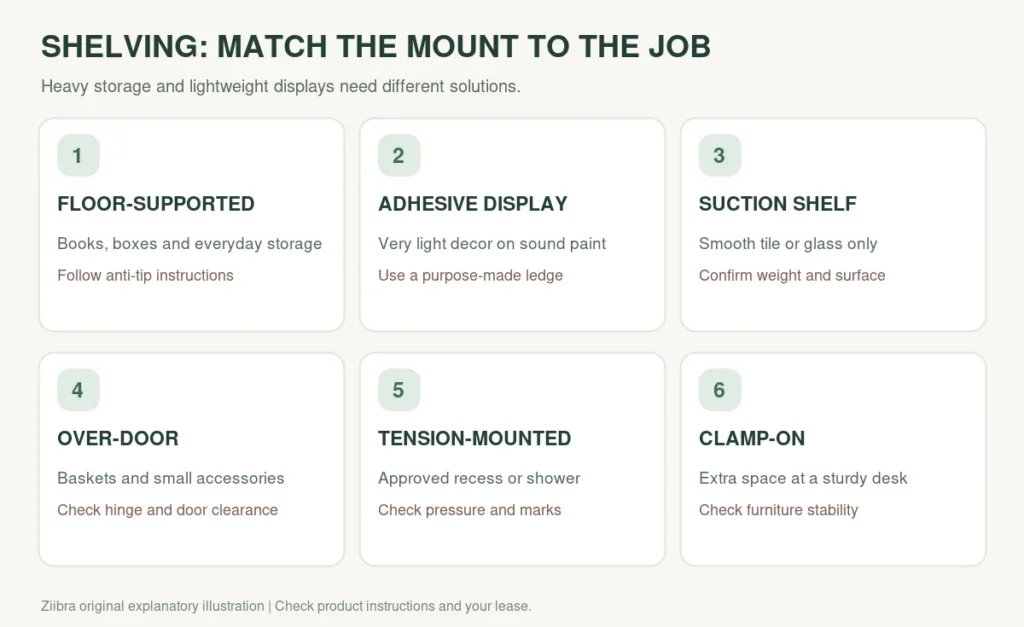
Renter-friendly shelves at a glance: which method should you choose?
| Method | Good for | Wall or door contact | Main limitation |
|---|---|---|---|
| Low freestanding shelf or rolling cart | Everyday storage, books and baskets when the product is rated for the load | No wall adhesive; some furniture still needs anti-tip anchoring | Uses floor space; follow the furniture maker’s anchoring instructions |
| Purpose-made adhesive display ledge | Small prints, light ornaments and mini collections | Adhesive touches a suitable wall | Small rated load; weak paint may lift during removal |
| Suction-cup shelf | Light bathroom items on suitable smooth tile or glass | Suction touches a smooth surface | Not suitable for painted drywall or textured tile |
| Over-door shelf or organizer | Accessories, cleaning supplies, lightweight pantry items | Hooks contact the top of a suitable door | Door clearance, hinge strain, and possible rubbing |
| Tension-mounted shelving system | Shower corners or a properly sized recess | Pressure against floor, ceiling or opposing surfaces | Compatibility and pressure marks; weight is product-specific |
| Furniture-mounted or clamp-on shelf | Desk supplies or a little extra workspace | Clamp contacts existing furniture | Furniture thickness, finish and stability must suit the clamp |
The distinction that matters: “No drill” does not mean “no holes,” “no wall contact,” or “safe for any weight.” For example, a push-in nail or drywall claw avoids a power drill but still makes holes. A removable adhesive avoids holes but may take poorly bonded paint with it. If your lease prohibits all wall damage, begin with an appropriate floor-supported solution.
1. Low freestanding shelves: best for actual storage
If you have a pile of books, spare towels, baskets, or kitchen supplies, start here. A compact floor-supported shelf puts the load through its legs rather than through a small adhesive patch on drywall. Narrow rolling carts can also fit beside a desk or between appliances if their dimensions and wheel clearance actually fit the gap.
For a studio apartment, a shallow, low shelving unit can double as a room divider or sit beside a sofa without demanding permanent fittings. Closed baskets reduce visual clutter; open shelves make everyday objects easier to reach. Before buying, measure the width, depth, door swing and walking clearance, not just the available wall length.
Safety catch: “Freestanding” does not mean “never anchor.” Tall, narrow, heavily loaded or manufacturer-designated units may require wall anchoring to prevent tip-over. Follow the exact assembly instructions and do not omit a required restraint merely because you rent. If you cannot obtain permission to anchor a particular unit, choose a different, appropriately stable storage product rather than using it contrary to its instructions. IKEA’s furniture tip-over safety guidance explains why anchoring matters.
Best for: books, folded clothes, shoes, baskets and other genuinely useful storage. Skip when: even a small floor footprint blocks a doorway or the product cannot be used safely without a prohibited anchor.
2. Adhesive display ledges: best for lightweight decor, not book storage
Adhesive ledges are the closest thing to a true no-hole floating shelf. But buy a purpose-designed shelf with its own mounting system, not an ordinary shelf and a handful of picture-hanging strips. A shelf projects away from the wall and creates outward leverage; the load is different from a flat picture frame.
As a concrete example, the Command Display Ledges HOM23Q-2EF are specified by the manufacturer at 2 lb (0.9 kg) for the listed product. That is suitable for small decorative objects within its instructions, not a stack of hardcover books. A different model, size, or mounting kit may have a different rating.
Check four things before using an adhesive ledge:
- Surface: Smooth, sound, fully cured paint or another surface specifically approved by the manufacturer. Wallpaper, loose paint and heavy texture are warning signs.
- Total permitted load: Follow the exact shelf’s weight rating, including any restrictions about the number and placement of objects. Do not assume adding extra strips increases it.
- Placement: Avoid valuable, breakable or irreplaceable items, and avoid positions above beds, seating, cribs and busy walkways where a falling item could hurt someone.
- Removal: Confirm that the adhesive release tab will remain accessible. Follow its removal instructions without pulling the mount outward.
3M’s installation instructions for hooks, ledges and caddies specify appropriate surface preparation and removal techniques and advise waiting seven days after painting for its relevant products. Follow the exact packaging when it differs.
Paint damage is still possible on fragile rental walls. For the reasons adhesive succeeds or fails, read our guide to Command Strips and painted walls.
3. Suction-cup shelves: useful on smooth tile and glass
In a small bathroom, the wall over a sink or beside a shower may be the only spare space. A suction-cup caddy can organize a few everyday essentials without putting adhesive on paint or drilling tile. It depends on a compatible smooth, nonporous surface, not rough grout, textured tile or painted drywall.
The IKEA ÖBONÄS wall shelf with suction cup provides a useful real-world example: its US listing specifies a maximum load of 2 lb. That makes it a light organizer, not a place for large, heavy refill bottles. Do not treat its rating as a universal standard for other suction shelves.
Check that the mounting pads land on flat tile or glass rather than crossing grout lines. Clean and install according to the product’s instructions, allow required settling time if specified, and inspect the attachment periodically. Be especially cautious with glass containers, electrical items and anything that could fall into a bath or shower.
Best for: a few lightweight toiletries on compatible surfaces. Skip when: the only available surface is painted plaster, rough stone or a heavily textured tile.
4. Over-door shelves and hanging organizers: storage without touching the wall
An over-door organizer uses an existing door instead of a painted wall. The simplest versions have pockets, but some provide shallow rigid shelves or baskets for cleaning supplies, hair accessories, small pantry packets and folded washcloths.
Measure the door thickness, top gap, jamb clearance and direction of swing before choosing one. A hook that looks slim can still stop the door from closing. Check the product’s rated load and the door’s condition; hanging heavy objects high on a lightweight or damaged door may be inappropriate. Avoid overloading or obstructing an exit, especially in a tiny apartment.
Adhesive felt pads or metal hooks can scuff certain finishes, so inspect contact points. The door may stay hole-free while its paint or trim still becomes marked. If it rubs, do not force the door closed.
Best for: closet doors, bedroom doors and utility storage where clearance allows. Skip when: the door is a fire-rated opening, must self-close, or the organizer would interfere with its safe operation.
5. Tension-mounted shelves: excellent in the right recess, poor on the wrong surface
Tension systems hold themselves in place by pressing against opposing surfaces or, in some shower caddies, between the floor and ceiling. They are useful when a rental has an awkward shower corner or a narrow recess, but they are not automatically safe for every plaster ceiling or drywall opening.
Measure the installation height or span at multiple points; check whether the product is designed for that orientation and surface. Adjustable tension does not compensate for a cracked ceiling, weak plaster, slippery finish or a measurement outside the supported range. Too much pressure can also leave marks.
Keep loads evenly distributed according to the maker’s instructions, rather than stacking heavy bottles or containers at one end. If the system can loosen, it should not hold fragile objects.
Best for: bathrooms or recesses for which the manufacturer explicitly approves the mounting arrangement. Skip when: the product depends on excessive pressure against a weak or unsuitable surface.
6. Clamp-on shelves: borrow strength from furniture you already have
Some desk shelves, monitor risers, and side-storage trays attach to a compatible desk edge or furniture frame. These can add space for stationery, small electronics or lightweight accessories without contact with rental walls.
Measure tabletop thickness, clearance underneath and any lip or support rail that blocks the clamp. Confirm that the desk or furniture is itself stable and rated for the additional load. Protect finishes only with pads or barriers permitted by the clamp manufacturer; improvised packing can compromise the grip. Avoid clamping to glass, particleboard edges or delicate veneers unless the product expressly allows it.
Best for: a work-from-home desk or study nook. Skip when: the furniture cannot safely support a clamp or the shelf would project into a walking route.
A worked example: choosing storage for three different belongings
Imagine a renter has a 12-inch framed print, six hardcover books and a small bottle collection. Those objects need three different solutions. The framed print might be suitable for a purpose-made, correctly rated adhesive display ledge on approved smooth paint. The books are better on a manufacturer-rated floor-supported unit used with any required anti-tip anchoring. Lightweight toiletries may belong in a compatible suction caddy on smooth tile rather than on painted drywall.
Do not convert a picture-hanging strip rating into a shelf rating. Shelves project outward and add leverage to their mounts. Weigh the actual items, inspect the wall, read the exact product instructions and choose the method that is designed for that load and surface.
Which renter-friendly shelf works for your wall and your belongings?
Use this quick decision checklist before buying:
- Are you storing books, heavy plants, cookware or several kilograms of supplies? Look for a properly rated floor-supported unit or an appropriately anchored solution with permission. Do not ask an adhesive ledge to perform heavy-storage duties.
- Do you want to display one or two lightweight objects on smooth, sound paint? A purpose-designed adhesive ledge may suit the job if its specific rating and instructions permit it.
- Do you need bathroom storage on flat tile or glass? Consider a suction shelf designed for that exact surface and moisture environment.
- Do you have no suitable wall surface? Measure for over-door, furniture-mounted or low freestanding storage instead.
- Are you uncertain about lease rules or paint quality? Avoid wall-contact products until you have checked. Written permission is more reliable than assuming a product labeled “renter-friendly” is permitted.
If the real problem is too much stuff in one room, start by deciding what you need to keep. Our small apartment layout ideas explain how to organize zones without blocking movement; our studio apartment ideas cover the larger room plan.
Three rental mistakes that make shelving less safe
Using high-capacity picture strips to hold an ordinary shelf
Weight ratings for a picture hanging system do not automatically transfer to a shelf that projects from the wall. Use only a shelf and mount intended to work together. It is not a reliable DIY upgrade to stack extra picture strips behind a heavy piece of wood.
Confusing “no drilling” with “no deposit risk”
Adhesive can take weak paint with it; tension mounts can mark finishes; over-door hooks can scrape trim; and push-in hooks make holes. Check the lease and wall condition before choosing a method. For alternative decor that never hangs from a wall, see our renter-friendly wall decor guide.
Choosing a tall unit without reviewing anti-tip instructions
Floor-supported does not automatically mean tip-over safe. Tall shelves, cabinets and bookcases often need restraints. Use them according to their manufacturer’s instructions and keep children from climbing furniture. If your lease creates a conflict with essential anchoring, ask for approval or choose another design.
How to make simple shelves look intentional in a small apartment
Use two visual rules. First, concentrate heavy and bulky objects low: baskets, spare linens and books near the bottom of an appropriately stable unit. Second, limit the top to a few light objects, allowing some empty space to prevent a narrow room from feeling crowded.
Match one finish to something already in the room—a white desk, a dark lamp, a natural-wood side table—rather than introducing a fourth furniture color. For an underused corner, a narrow rolling cart might be more useful than a decorative wall ledge. For a small bedroom, under-bed containers may be a better fit than adding storage above the bed; see our guide to under-bed storage with wheels for clearance measurements.
No-drill shelving products to compare
These are examples of two different jobs: a freestanding storage solution and a very light wall display. They are not interchangeable.
-
Amazon Basics three-tier rolling utility cart
When it helps: A floor-supported, movable place for small supplies instead of mounting shelves to rental paint.
Check first: Measure its footprint and route, confirm wheel and load specifications, and use the wheel locks appropriately.
-
Command Quartz display ledges (two-pack)
When it helps: Small decorative items on surfaces approved by the manufacturer; each ledge is listed for up to 2 lb.
Check first: Not for heavy books. Follow the specified surface, installation and removal instructions; paint damage is still possible.
Selections are based on published specifications and suitability, not hands-on testing. Prices and availability can change; verify the exact Amazon listing and manufacturer instructions before buying.
Frequently asked questions about renter-friendly shelves
Can I install floating shelves without drilling?
Yes, but most genuine no-drill wall-mounted options are lightweight display ledges with a specific manufacturer-approved adhesive or suction mount. They are not interchangeable with conventional floating shelves designed for screws and anchors.
Do Command strips hold shelves?
Only use an adhesive shelving product for which the manufacturer provides that mounting method and load rating. Picture-hanging strip capacity is not proof that a separate wooden or metal shelf can be mounted safely.
Can renters install shelves in drywall?
It depends on the lease and the installation method. Drywall anchors and screws create holes, even if those holes can later be patched. Obtain permission where needed, and use fittings appropriate to the wall and load. “No-drill” claws still make holes and are not a substitute for heavy-duty shelf anchors.
Which option is safest for heavy books?
A properly rated storage product that is stable and secured exactly as its manufacturer requires. Avoid adhesives and suction shelves for heavy book collections. Even a freestanding bookcase may require anti-tip anchoring.
Will adhesive shelves damage rental paint?
They can. Smooth, well-bonded and appropriately cured paint lowers risk but does not guarantee a perfect removal. Follow the manufacturer’s preparation and release process, and do not use adhesives on wallpaper or damaged paint unless the exact product expressly permits it.
What is the easiest option if I am moving again soon?
Usually a compact, appropriately stable rolling cart or low floor-supported unit. It moves with you and does not depend on your next apartment having the same wall finish, tile or doorway measurements.
The bottom line
Buy for the actual load and mounting surface, not the “renter-friendly” label. Use light adhesive ledges as display space, suction shelves for the specific surfaces they are designed for, and stable floor-supported furniture for the bulk of your storage—subject to any required tip-over protection. It is better to leave one small wall empty than risk damaged paint or a shelf that fails under weight.
Sources consulted: Command installation and removal instructions; Command Display Ledge specifications; IKEA ÖBONÄS specifications; IKEA furniture anchoring guidance. Always consult current instructions for the exact product purchased.